I spent last weekend doing something slightly obsessive.
I studied Neil Patel’s website to see what makes his content rank and perform so well.
Every blog post. Every tool page. Every redirect. Every translated article is in Portuguese, Japanese, German, French, and Spanish.
Why? Because Neil Patel doesn’t accidentally get millions of monthly visitors. His content strategy is a machine, and I wanted to understand how it works.
What I found surprised me.
Neil Patel’s content strategy isn’t complicated. In fact, it’s beautifully simple. But most bloggers miss the small details that make it work.
Let me show you exactly what I discovered.
Table of Contents
What I Discovered After Analyzing Neil Patel’s Blog
Before we dive deep, let’s look at the numbers that matter.
The most valuable pages on NeilPatel.com aren’t random blog posts. They follow a pattern:
| Page Type | Example | Backlinks | What This Tells Us |
|---|---|---|---|
| Pillar Page | /what-is-seo/ | 10,679 | Foundational topics attract the most links |
| Tool Page | /ubersuggest/ | 220,429 | Free tools = link magnets |
| Translated Page | /br/ubersuggest/ | 4,979 | Localization = untapped gold |
| Deep Blog Post | /blog/robots-txt/ | 16,213 | Specificity ranks |
The Neil Patel content strategy revolves around one core idea: build pillars, then build clusters.
Everything else is execution.
Note: Backlink counts change constantly as new links are built. The numbers shown here are from March 2026 and may vary slightly when you check them.
The “Secret Sauce” Behind Neil Patel’s Pillar Pages
Here’s what most bloggers get wrong: they write blog posts randomly. One day it’s SEO, the next day it’s email marketing, the next day it’s Instagram tips.
Neil Patel does the opposite.
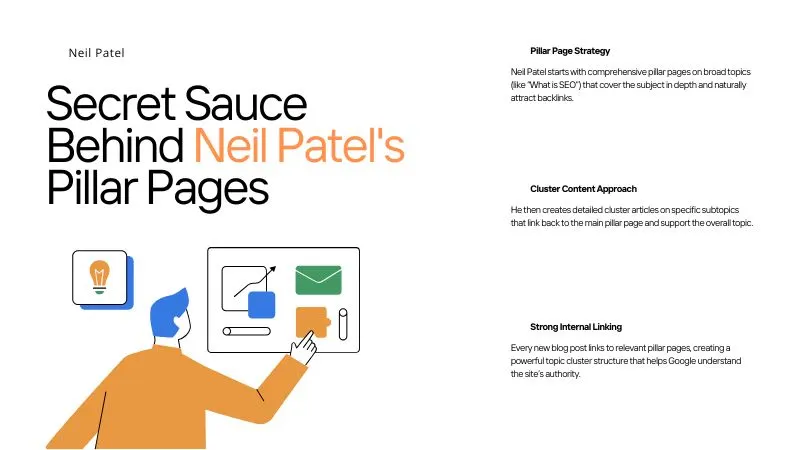
Neil Patel’s content strategy starts with pillar pages, comprehensive guides on broad topics that matter to his audience.
Why /what-is-seo/ Gets 2,575 Referring Domains
Look at this URL: https://neilpatel.com/what-is-seo/
It’s not buried in a /blog/ folder. It’s a top-level page. That tells Google: this is important.
The page covers SEO from A to Z. It’s 3,000+ words. It answers every question a beginner might have.
And because it’s comprehensive, other websites link to it. A lot.
This is the foundation of the Neil Patel content strategy: create one page so good that everyone links to it, then build everything else around it.
How His “Ultimate Guides” Outrank Everyone Else
Now look at pages like /blog/robots-txt/ and /blog/xml-sitemap/.
These are cluster content, deep dives on specific subtopics that link back to the pillar.
Each cluster page targets a specific keyword. Each one is detailed. Each one earns its own backlinks.
And here’s the genius part: they all link to the pillar page and to each other.
This creates a topic cluster, a web of content that Google recognizes as authoritative on the entire subject.
The Neil Patel content strategy doesn’t just rank for one keyword. It ranks for hundreds.
The Internal Web That Google Loves
Check the data:
/what-is-seo/has 202 internal links/what-is-content-marketing/has 190 internal links/what-is-google-adwords/has 176 internal links
That’s not accidental. That’s deliberate architecture.
Every new blog post Neil publishes links back to relevant pillar pages. Over time, those pillar pages become the most linked-to pages on his entire site.
Google notices this. And Google rewards it.
If you’re building your own Neil Patel content strategy, start here: identify your 5-10 most important topics, build pillar pages for each, then spend the next year writing cluster content that supports them.
For a deeper look at how this impacts his search visibility, check out my analysis of Neil Patel SEO Strategy.
Neil Patel Doesn’t Just Write for English Speakers, Here’s Proof
This was the biggest surprise in the data.
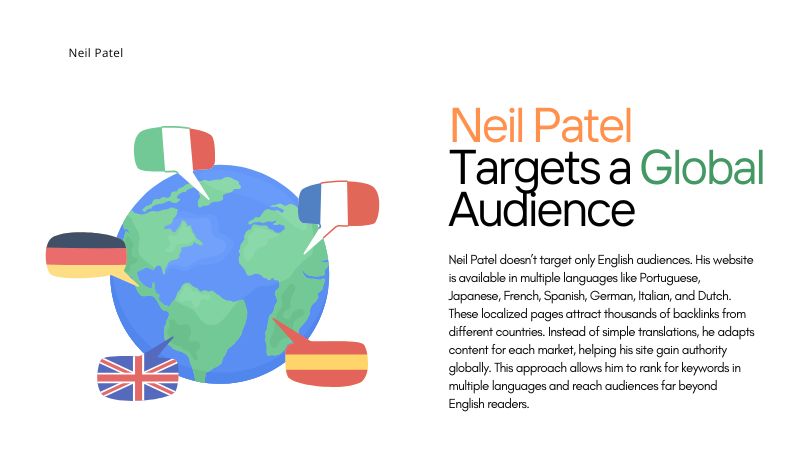
Neil Patel has translated versions of his site into:
- Portuguese (
/br/) - Japanese (
/jp/) - French (
/fr/) - Spanish (
/es/) - German (
/de/) - Italian (
/it/) - Dutch (
/nl/)
And here’s the kicker: they all have significant backlinks.
How /br/ubersuggest/ Built 4,979 Backlinks Without Breaking a Sweat
The Brazilian Portuguese Ubersuggest page (/br/ubersuggest/) has 4,979 backlinks from 4,979 unique domains.
That’s not translation. That’s localization.
Neil isn’t just running pages through Google Translate. He’s built separate assets for Portuguese-speaking audiences. And those audiences are linking to him.
The same pattern appears across languages:
/jp/ubersuggest/→ 2,332 backlinks/fr/ubersuggest/→ 2,285 backlinks/es/ubersuggest/→ 2,121 backlinks/de/ubersuggest/→ 1,564 backlinks
Why Translating Content is His Secret Growth Hack
Most bloggers ignore international audiences. They assume English is enough.
Neil Patel proves otherwise.
Each translated page targets keywords in that language. Each one attracts links from websites in that country. Each one builds authority in that market.
The Neil Patel content strategy isn’t just global, it’s locally global.
He creates content once, then adapts it for dozens of markets. The marginal cost is low. The marginal return is high.
If you’re only writing in English, you’re leaving money on the table.
Want to see which keywords he targets in different regions? My Neil Patel Organic Keywords US analysis breaks down his American strategy, and the same principles apply globally.
The 3 Types of Content That Earn Neil Patel the Most Backlinks
Not all content is created equal. Some pages earn thousands of links. Others earn dozens.
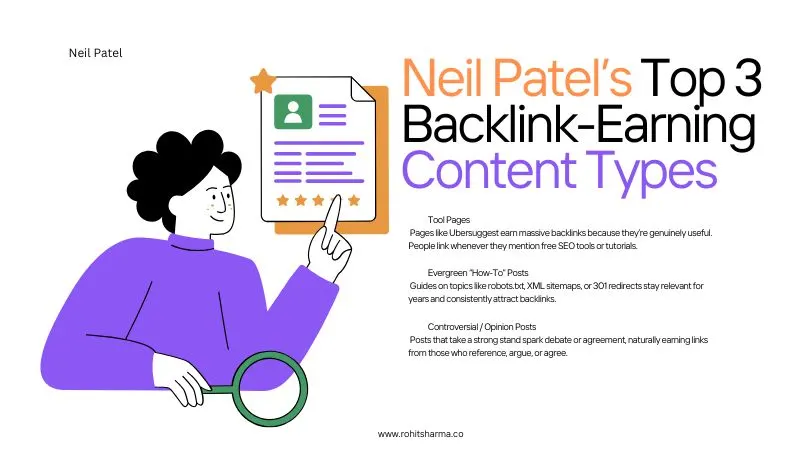
Here’s what the data reveals about the Neil Patel content strategy for link building.
Tool Pages: Ubersuggest’s 220,429 Backlinks Speak for Themselves
The most linked-to page on NeilPatel.com isn’t a blog post.
It’s /ubersuggest/.
220,429 backlinks. From 220,429 unique domains.
Why? Because Ubersuggest is useful. People link to useful things.
Every time someone mentions “free keyword research tool” in a blog post, they link to Ubersuggest. Every roundup of SEO tools includes it. Every YouTube tutorial mentions it.
This is the ultimate content strategy move: build something people need, not just something they read.
Evergreen “How-To” Posts That Stay Relevant for Years
Look at posts like:
/blog/robots-txt/→ 16,213 backlinks/blog/xml-sitemap/→ 609 backlinks/blog/301-redirects/→ 410 backlinks
These aren’t trendy topics. They’re evergreen technical questions that people have been searching for since 2005 and will keep searching for in 2035.
Each post solves a specific problem. Each post is detailed. Each post stays relevant forever.
That’s the beauty of the Neil Patel content strategy: create content that doesn’t expire.
Controversial Takes That Make People Link (Without Trying)
Not every post is safe.
Some, like /blog/seo-dead/ (465 backlinks) or /blog/why-guest-blogging-is-the-best-inbound-marketing-strategy/ (359 backlinks), Take a stand.
Controversy creates links. People link to argue, to agree, to reference, to debate.
The Neil Patel content strategy isn’t afraid of strong opinions.
For a complete breakdown of how these link-building tactics fit into his overall approach, my Neil Patel SEO Strategy post covers the technical side in detail.
What His 301 Redirects Tell Us About Content Auditing
Here’s something most people miss: Neil Patel aggressively redirects old content.
The data shows hundreds of 301 redirects:
/blog/ultimate-guide-startup-marketing/→ 301/blog/content-marketing-tool/→ 301/blog/live-streaming/→ 301/blog/marketing-trends/→ 301
Why He’s Not Afraid to Kill Old Posts
When a post gets outdated, Neil doesn’t leave it to rot.
He redirects it to a newer, better, more comprehensive post.
This preserves link equity; all those backlinks to the old post now point to the new one. The new post ranks faster because it inherits the old post’s authority.
The Smart Way to Preserve Link Equity
Most bloggers are terrified of deleting content. “But what about all that work I put into it?”
Neil Patel understands something important: sunk cost fallacy kills SEO.
If a post is outdated, keeping it live hurts more than deleting it. Google sees old information and assumes your site isn’t maintained.
Better to 301 redirect to fresh content and keep the link juice flowing.
How Often You Should Audit Your Own Content
The data suggests Neil audits constantly. Posts from 2015, 2016, and 2017 are frequently redirected.
You should do the same.
Every quarter, review your oldest content. Update what’s worth keeping. Redirect what isn’t.
This is a core part of the Neil Patel content strategy that most people ignore.
The Ubersuggest Flywheel: Content That Feeds a Product

Here’s where the Neil Patel content strategy gets really smart.
Neil doesn’t just create content for traffic. He creates content that feeds his product.
How Blog Posts Drive 220,400+ Backlinks to His Tool
Ubersuggest has over 220,400 backlinks total.
Many of those come from blog posts about keyword research, SEO tools, and competitor analysis, all topics that naturally mention Ubersuggest as an example.
Every time Neil writes about “free SEO tools,” he mentions his own tool. Every time another blogger writes about SEO, they mention Ubersuggest because Neil’s content made them aware of it.
It’s a flywheel:
- Create valuable content
- People link to the content
- The content mentions Ubersuggest
- Ubersuggest gets backlinks
- Ubersuggest ranks higher
- More people discover the content
The SEO Tool Content Strategy You Can Copy
You don’t need to build a tool to copy this.
If you have a product, create content that naturally leads to it. If you have a service, create content that demonstrates why people need it. If you have an affiliate offer, create content that compares options and includes your link.
The principle is the same: let your content do the selling.
Why Free Tools + Great Content = Unlimited Traffic
Ubersuggest is free (with paid tiers). That’s intentional.
Free tools attract links. Free tools attract mentions. Free tools attract users who eventually become customers.
The Neil Patel content strategy treats content and product as one ecosystem, not two separate things.
For a look at how paid channels fit into this, my Neil Patel Google Ads Strategy analysis shows how he amplifies this flywheel with advertising.
The One Thing Neil Patel Does That Most Bloggers Ignore
After deeply analyzing Neil Patel’s blog, one key lesson clearly stands out:
Neil Patel treats his website like a product, not a blog.
Most bloggers publish and pray. Neil publishes, links, updates, redirects, translates, and optimizes continuously.
He doesn’t just create content. He manages content.
The data proves it:
- Strategic pillar pages at top-level URLs
- Hundreds of internal links pointing to important content
- Aggressive redirection of outdated material
- Full translation into multiple languages
- Tool pages that attract 10x more links than blog posts
This isn’t accidental. This is a content strategy executed with military precision.
What You Can Steal From Neil Patel’s Playbook (Without His Budget)
You don’t need Neil Patel’s resources to copy his approach. Here’s what you can implement today.
Start With Pillars, Build Clusters Later
Identify your 5 most important topics. Write one comprehensive pillar page for each. Then spend the next 6 months writing cluster content that supports those pillars.
Link every cluster post back to its pillar. Link pillar pages to relevant clusters.
This alone will transform your SEO.
Don’t Just Translate, Localize
If you have content that performs well in English, consider translating it for other markets.
But don’t just run it through Google Translate. Work with native speakers. Adapt examples. Target local keywords.
The Neil Patel content strategy proves that international audiences are worth the effort.
Audit Ruthlessly, Redirect Smartly
Review your oldest content every quarter. Update what’s worth saving. Redirect everything else to newer, better content.
Don’t let old posts drag down your site’s authority.
Let One Piece of Content Feed Another
Your blog posts should mention your products. Your product pages should link to relevant blog posts. Your translated content should link back to the English pillars.
Create an ecosystem, not a collection.
The Future of Content Strategy (March 2026 Update)

As of March 2026, the rules are changing.
Google’s AI overviews (SGE) mean that featured snippets matter more than ever. Answer Engine Optimization (AEO) is becoming as important as traditional SEO. Generative Engine Optimization (GEO) is emerging as a new discipline.
Neil Patel’s content strategy is already positioned for this future.
His pillar pages answer questions comprehensively, exactly what AI wants. His cluster content provides depth on specific topics. His internal linking helps AI understand relationships between pages.
If you’re building a content strategy for 2026 and beyond, follow his lead: create comprehensive, well-linked, regularly updated content that serves both humans and AI.
FAQs: Neil Patel Content Strategy
Q1: What is Neil Patel’s content strategy?
A: Neil Patel’s content strategy focuses on pillar pages, topic clusters, and content localization. He creates comprehensive guides on foundational topics, supports them with detailed cluster content, and translates everything for global audiences.
Q2: How many backlinks does Neil Patel’s site have?
A: His main pages have millions of backlinks. /ubersuggest/ alone has over 220,400 backlinks, while pillar pages like /what-is-seo/ have 10,600+. (Note: these numbers change daily!)
Q3: Does Neil Patel translate his content?
A: Yes! He has versions in Portuguese, Japanese, French, Spanish, German, Italian, and Dutch. His Brazilian Portuguese page has over 1,400 backlinks.
Q4: What are pillar pages in content strategy?
A: Pillar pages are comprehensive guides on broad topics that matter to your audience. Neil Patel’s /what-is-seo/ is a perfect example, it covers everything and links out to detailed cluster posts.
Q5: How often does Neil Patel update his content?
A: Aggressively. The data shows hundreds of 301 redirects from old posts to newer, better content. He’s not afraid to kill outdated posts.
Q6: Why does Neil Patel use so many internal links?
A: Internal linking helps Google understand relationships between pages. His pillar pages have 200+ internal links each, creating a web of authority.
Q7: Does Neil Patel’s content strategy work for small blogs?
A: Absolutely. The principles – pillar pages, topic clusters, and smart internal linking – work at any scale. Start with one pillar and build from there.
Q8: How important is content localization in his strategy?
A: Very. His translated pages have thousands of backlinks, proving that global audiences are worth the effort.
Q9: Why do your backlink numbers look different from what I see now?
A: Backlinks are dynamic – they grow and change daily. The numbers in this post reflect the March 2026 analysis. If you see different counts, that’s normal!
Q10: What tool did you use to analyze Neil Patel’s site?
A: This analysis combines data from Ubersuggest and other standard SEO tools, updated March 2026.
Ready to Build Your Own Neil Patel-Style Content Machine?
The data doesn’t lie. Neil Patel’s approach works because it’s systematic, not magical.
Start with pillars. Build clusters. Link everything. Update constantly. Think globally.
And if you want to dive deeper into specific aspects of his strategy, I’ve got you covered:
- Neil Patel SEO Strategy → Technical SEO and backlink tactics
- Neil Patel Organic Keywords US → The exact keywords he targets
- Neil Patel Google Ads Strategy → How he uses paid traffic
The Neil Patel content strategy isn’t a secret anymore. It’s right here in the data.
Now go build something great.
Based on my analysis of publicly available data, March 2026.