SEO stands for search engine optimization. It helps your website appear when people search on Google. When done right, search engine optimization SEO brings free, consistent traffic to your site.
But in 2026, SEO isn’t just about Google anymore. You also need to think about AEO (Answer Engine Optimization), GEO (Generative Engine Optimization), and AIO (AI Optimization). Let me explain everything in simple words.
Key Takeaways
- SEO stands for search engine optimization – It helps your website rank higher on Google and get free, consistent traffic without paying for ads.
- SEO works through three steps – Crawling (bots discover pages), Indexing (pages stored in a database), and Ranking (search engine shows best results).
- Modern SEO includes AEO, GEO, and AIO – Optimize for answer engines, generative AI like ChatGPT, and AI models to stay ahead in 2026.
- The 3 pillars of SEO are On-page, Off-page, and Technical – Focus on content + keywords, backlinks + social media, and site speed + mobile-friendliness.
- Create high-quality content and earn backlinks – Write for humans first. Use short sentences, subheadings, and alt text. Build authority through ethical link building.
- Avoid black hat tactics – Never do keyword stuffing, duplicate content, or buy links. These can get your site penalized or banned.
- SEO is a marathon, not a sprint – Results take 6-12 months of consistent effort. Use free tools like Google Search Console to start your journey.
What Is SEO?
SEO stands for Search Engine Optimization. At its core, it is the process of improving your website to increase its visibility when people search for products or services related to your business in Google, Bing, and other search engines.
To put it simply, SEO is the art of making your content understandable and valuable to both humans and search engine algorithms. In 2026, this means moving beyond just “keywords” and focusing on Information Gain – providing unique value that AI models and traditional crawlers can’t find elsewhere.
The Goal of SEO in 2026
The primary goal is no longer just “ranking #1.” Modern SEO aims to build a digital authority so strong that your site becomes the “source of truth” for:
- Traditional Search: Ranking in the classic blue links on Google.
- AI Overviews: Being cited as a reference in Generative AI summaries.
- Voice & Assistant Queries: Providing the “single best answer” for voice-activated devices.
How Do Search Engines Work?
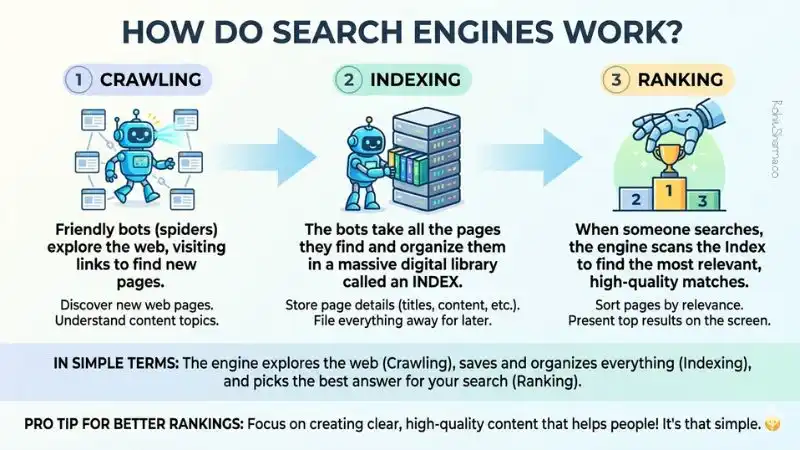
Search engine crawlers are automated bots that browse the web pages of the internet constantly. They follow links from one page to another, discovering new content every second.
Once these crawlers find your content, they perform three actions:
- Crawling – Bots discover your web pages
- Indexing – Your pages get stored in a database called an index
- Ranking – When someone types search queries, the search engine scans the index to find the most relevant results
Search engines understand your content through these processes. The better they understand it, the higher your search engine rankings.
The Three Steps in Detail
Crawling: Search engine crawlers visit your site by following links. If your site structures are clear and organized, crawlers can find all your important content easily. A well-planned site structure acts like a roadmap.
Indexing: Your pages get stored. During this stage, search engines understand what your content means and what questions it answers.
Ranking: When someone performs a search query, the search engine sorts through billions of indexed pages to find the best matches. Your position on the results page determines how many people find you.
Why Is SEO Important in 2026?
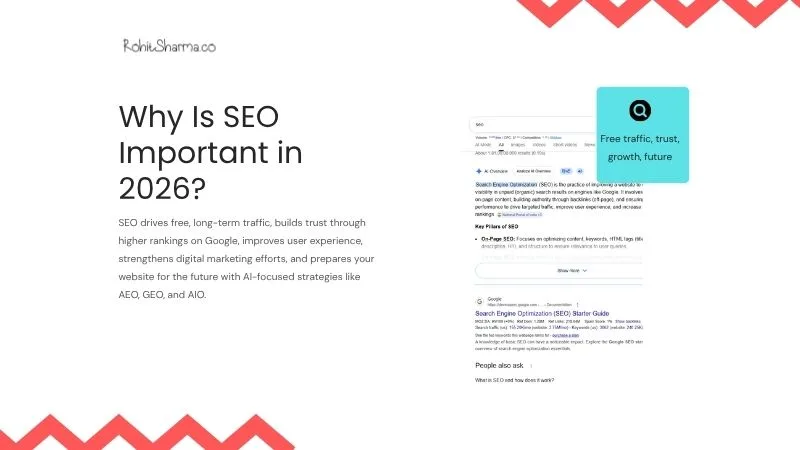
You might wonder why search engine optimization SEO deserves your attention. Here are five compelling reasons:
1. Free, Sustainable Traffic
Unlike paid ads that stop working when your budget runs out, SEO provides lasting results. When you create high-quality content optimized for Google search, you attract visitors consistently over time.
2. Builds Credibility
Websites that appear at the top of search engine results pages (SERPs) earn instant trust. Users believe Google shows them the best results. When your site ranks well, that trust transfers to your brand.
3. Improves User Experience
Good SEO forces you to focus on user experience. Fast loading times, mobile-friendly design, and easy navigation help both search engines and visitors.
4. Supports Digital Marketing Goals
SEO is the foundation of any digital marketing strategy. Whether you run paid ads, email campaigns, or social media marketing, SEO amplifies your efforts.
5. Prepares You for the AI Era
Modern SEO now includes AEO, GEO, and AIO. These new approaches help your content get featured in AI-generated answers, chatbots, and voice search results.
Modern SEO: Beyond Traditional Optimization
In 2026, search engine optimization seo has evolved. You now need to optimize for:
What Is AEO (Answer Engine Optimization)?
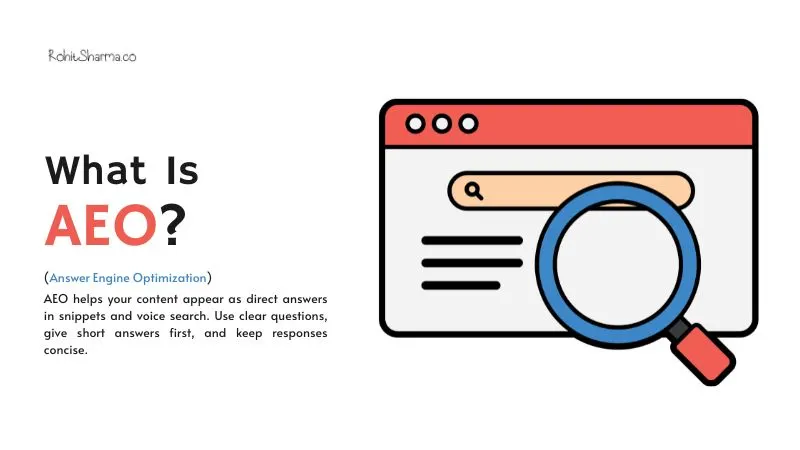
AEO focuses on getting your content featured as direct answers. When someone asks “what is SEO,” answer engines pull your content into featured snippets, voice search results, and quick answers.
How to optimize for AEO:
- Answer questions directly in the first paragraph
- Use question-based headings (H2s like “What is…”)
- Keep answers concise (40-60 words for voice search)
What Is GEO (Generative Engine Optimization)?
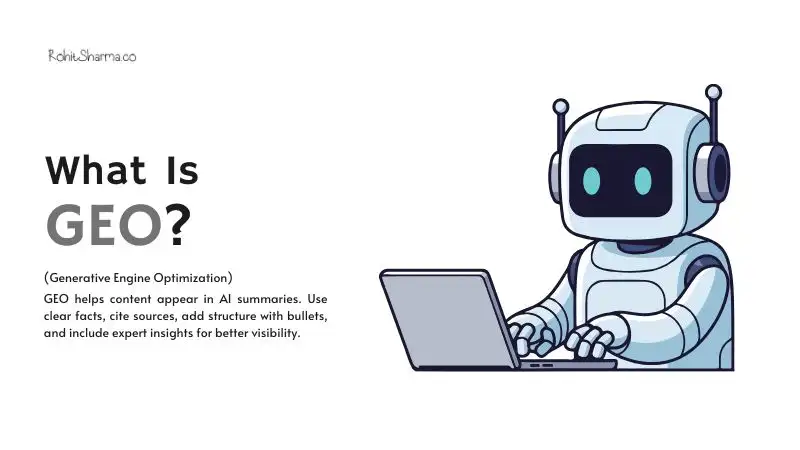
GEO helps your content appear in AI-generated summaries. Tools like ChatGPT, Google’s AI Overviews, and Perplexity pull information from multiple sources to create composite answers.
How to optimize for GEO:
- Use clear, factual language
- Cite sources and data
- Structure content with bullet points and tables
- Include expert opinions
What Is AIO (AI Optimization)?
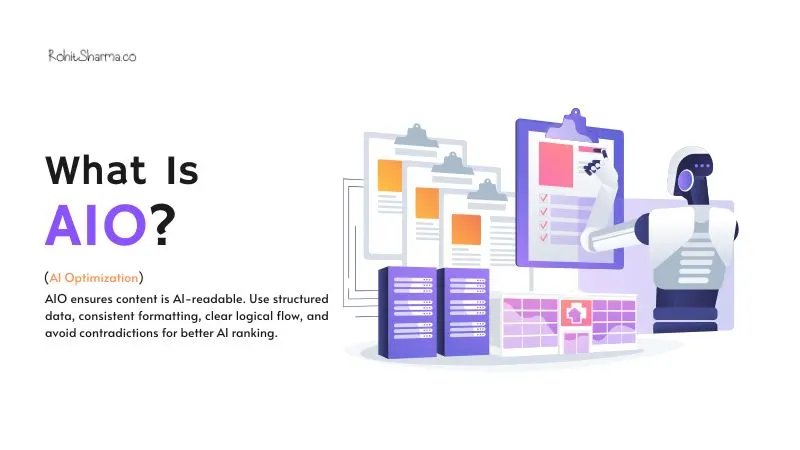
AIO is the practice of making your content machine-readable for AI models. As AI tools become the primary way people find information, optimizing for AI becomes essential.
How to optimize for AIO:
- Use structured data (schema markup)
- Maintain consistent formatting
- Write in a clear, logical flow
- Avoid contradictions within your content
What About EEAT?
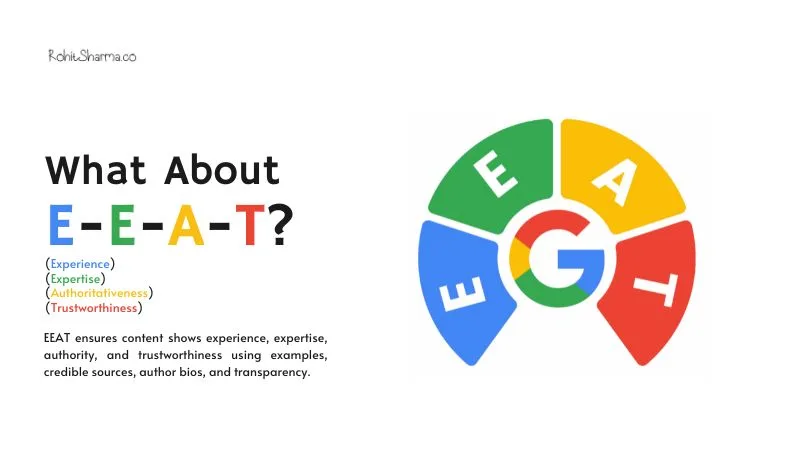
EEAT stands for Experience, Expertise, Authoritativeness, and Trustworthiness. While Google has stated that EEAT is not a direct ranking factor, it reflects the qualities of high-quality content.
How to demonstrate EEAT:
- Show real experience (case studies, examples)
- Cite credible sources
- Include author bios with credentials
- Be transparent about your business
The 3 Pillars of SEO
Successful search engine optimization SEO rests on three foundational pillars:
1. On-Page SEO

On-page SEO focuses on optimizing individual web pages. This includes everything visitors see and interact with.
Key elements of on-page SEO:
Title Tag and Meta Description: These appear in search engine results pages (SERPs). A compelling title tag with your focus keyword encourages clicks. A well-written meta description tells users what to expect.
Header Tags: Use H1, H2, and H3 tags to organize content logically. This helps search engines understand your page structure.
URL Structure: Clean, descriptive URLs help both users and crawlers. A good URL structure includes relevant keywords and avoids random numbers.
Alt Text: Descriptive alt text for images helps visually impaired users and gives search engines context.
High-Quality Content: Create high-quality content that answers user questions thoroughly. Your content should be original, valuable, and easy to read.
2. Off-Page SEO

Off-page SEO refers to actions taken outside your website. The most important factor here is link building.
Link building happens when other websites link to your content. This signals trust to search engines and improves your search engine rankings.
Effective link-building strategies:
- Create high-quality content that others want to share
- Guest post on reputable industry sites
- Use social media to promote your work
- Build relationships with influencers
Social media marketing amplifies your reach. When people share your content on platforms like LinkedIn, Twitter, and Facebook, you gain visibility and potential backlinks.
3. Technical SEO
Technical SEO ensures that search engine crawlers can access and index your site efficiently.
Essential technical elements:
Site Structures: A logical site structure helps crawlers navigate your content. Good site structures also improve user experience.
Mobile-Friendliness: Most Google search traffic now comes from mobile devices. Your site must work perfectly on phones.
Site Speed: Fast loading pages keep visitors happy and improve search engine rankings.
Google Search Console: Use Google Search Console to monitor how Google sees your site. This free tool shows crawl errors, indexing status, and search performance.
How to Do Keyword Research
Keyword research tools help you find what people actually search for. This is the foundation of effective SEO strategies.
Step-by-Step Process
- Brainstorm seed keywords – Start with basic terms related to your business. Your focus keyword is SEO.
- Use keyword research tools – Tools like Google Keyword Planner, Semrush, or Ahrefs show search volume and competition.
- Analyze search intent – Understand why people search. Are they looking to buy, learn, or compare?
- Find long-tail keywords – Longer phrases like “how to learn SEO for beginners” often convert better.
- Check competitors – See what keywords your competitors rank for.
Tools to Use
- Google Search Console shows which keywords bring traffic to your site
- SEO tools like Moz and Semrush provide deeper insights
- Free options like Ubersuggest work well for beginners
How to Create SEO-Friendly Content
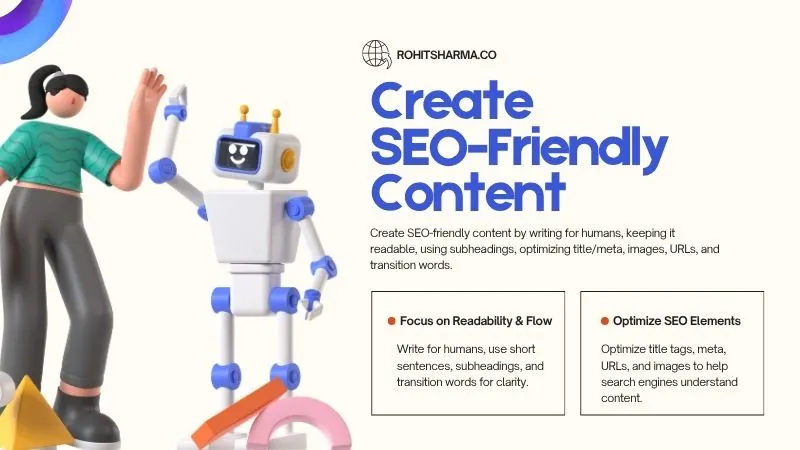
High-quality content is the heart of search engine optimization SEO. Without good content, all other efforts fail.
Content Creation Best Practices
Write for humans first. Google’s algorithms are sophisticated enough to recognize when content is genuinely helpful.
Keep it readable. Use short sentences and paragraphs. Aim for a 6th-grade reading level.
Use transition words. Words like “because,” “therefore,” and “however” improve flow.
Add subheadings regularly. Break up text every 300 words or so.
Include your title tag and meta description strategically. These elements appear in search engine results pages SERPs and influence click-through rates.
Optimize images. Use descriptive filenames and alt text for every image.
Structure your URL. A clean URL structure with keywords helps both users and crawlers.
How to Create High Quality Content That Ranks
When you create high-quality content, focus on:
- Originality – Don’t copy others. Share your unique perspective.
- Depth – Cover topics thoroughly. Thin content rarely ranks well.
- Accuracy – Fact-check everything. Cite sources when possible.
- Freshness – Update old content regularly.
- User experience – Make content easy to scan and digest.
How to Build High-Quality Backlinks
Link building remains one of the most powerful ranking factors. But not all links are equal.
White Hat Link Building Strategies
Create Linkable Assets: Publish original research, comprehensive guides, or useful tools that others want to reference.
Guest Posting: Write for reputable industry publications. Include a link back to your site in your author bio.
Broken Link Building: Find broken links on other sites and suggest your content as a replacement.
Digital PR: Get mentioned in news articles and industry roundups.
Social Media Marketing: Share your content on social media platforms. When people discover and share your work, links often follow naturally.
What to Avoid
- Buying links (violates Google’s guidelines)
- Link exchanges (trading links)
- Low-quality directories
- Spammy comments with links
White Hat vs Black Hat SEO: What’s the Difference?
Not all SEO techniques are created equal. Search engines reward some and punish others.
White Hat SEO (The Right Way)
White hat SEO follows search engine guidelines. It focuses on creating value for users. Results take time but last long.
Examples of white hat SEO:
- Creating helpful, original content
- Earning backlinks naturally through quality
- Optimizing site speed and mobile experience
- Using descriptive title tags and meta descriptions
- Writing alt text for images
Black Hat SEO (The Risky Way)
Black hat SEO tries to manipulate search engines. It looks for shortcuts and exploits weaknesses. Results can come fast but often disappear – along with your site.
Examples of black hat SEO (NEVER do these):
| Black Hat Tactic | What It Is | Risk |
|---|---|---|
| Keyword stuffing | Repeating keywords unnaturally | Google penalty, manual action |
| Cloaking | Showing different content to search engines vs users | De-indexing |
| Hidden text | White text on white background | Permanent ban |
| Link schemes | Buying links or link exchanges | Loss of rankings |
| Doorway pages | Low-quality pages made just for ranking | Complete removal |
| Content scraping | Copying content from other sites | Copyright issues, de-indexing |
| Spam comments | Posting links in irrelevant blog comments | Reputation damage |
Why Black Hat Is Not Worth It
Google’s algorithms are smarter than ever. They detect manipulation quickly. If caught:
- Your rankings drop overnight
- Your site gets removed from Google entirely
- Recovery takes months (or never happens)
- Your business loses all organic traffic
Bottom line: White hat SEO builds a lasting business. Black hat SEO builds a ticking time bomb.
Quick Comparison Table
| Factor | White Hat SEO | Black Hat SEO |
|---|---|---|
| Focus | Users | Search engines only |
| Speed | Slow, steady results | Fast, risky results |
| Longevity | Lasting rankings | Short-term gains |
| Risk | None | Penalties, bans |
| Cost | Time and effort | Time + potential loss |
| Google’s view | Rewarded | Punished |
Common SEO Mistakes to Avoid
Even experienced marketers make these errors. Avoid them to protect your search engine rankings.
1. Keyword Stuffing
Repeating your focus keyword unnaturally makes content hard to read. Use keywords naturally.
2. Duplicate Content
Copying content from other sites or even your own pages confuses search engine crawlers.
3. Poor URL Structure
Random numbers and symbols in URLs hurt user experience and crawler understanding.
4. Ignoring Mobile Users
Most Google search traffic now comes from mobile. Test your site on phones.
5. Neglecting Google Search Console
Google Search Console provides essential data about how Google sees your site. Check it regularly.
6. Forgetting Alt Text
Images without alt text miss ranking opportunities and accessibility.
7. Thin Content
Pages with little substance rarely rank well. Aim for comprehensive coverage.
8. Slow Loading Speed
Speed affects both user experience and search engine rankings.
Essential SEO Tools to Get Started
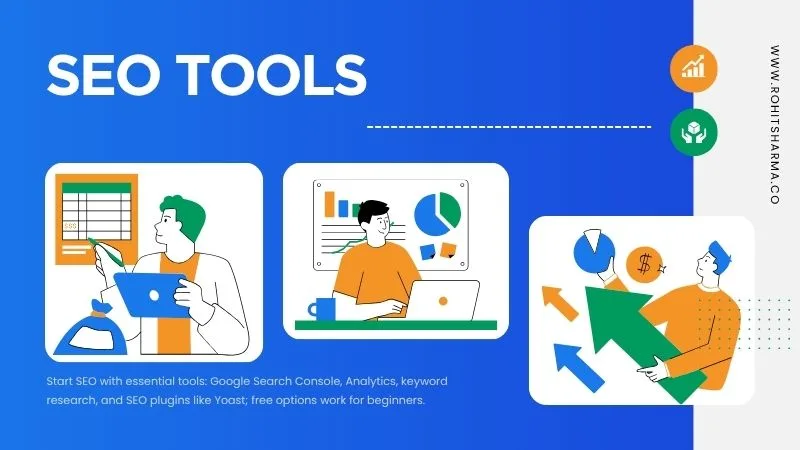
You don’t need expensive SEO tools to begin. Start with free options and upgrade as needed.
| Tool | Purpose | Cost |
|---|---|---|
| Google Search Console | Monitor indexing, search traffic, and issues | Free |
| Google Analytics | Track user behavior and traffic sources | Free |
| Keyword research tools (Ubersuggest, AnswerThePublic) | Find keywords and content ideas | Free/Paid |
| SEO tools (Moz, Semrush, Ahrefs) | Comprehensive analysis | Paid |
| Yoast SEO | WordPress optimization | Free/Premium |
FAQs About SEO
How long does SEO take?
Results vary. Some changes show in days, others take months. Consistent effort over 6-12 months typically shows significant improvement.
Can I do SEO myself?
Yes! With the right knowledge and tools, you can handle basic SEO strategies yourself.
What’s the difference between SEO and SEM?
SEO focuses on organic (free) traffic. SEM includes paid search advertising.
Is AI killing SEO?
No, AI is changing SEO. AEO, GEO, and AIO represent the evolution, not the end, of optimization.
How often should I update content?
Review and update important pages every 6-12 months. Keep information current.
Conclusion: Start Your SEO Journey Today
Search engine optimization SEO is not magic. It’s about understanding how search engine crawlers work and making your web pages easy to find.
Remember these key points:
- Google search rewards high-quality content that helps users
- Strong site structures help search engines understand your content
- Title tag and meta description influence click-through rates
- Link building and social media marketing build authority
- Google Search Console helps you monitor progress
- Modern approaches like AEO, GEO, and AIO prepare you for the future
- EEAT principles guide you toward creating trustworthy content
Your digital marketing success depends on getting found. Start applying these SEO strategies today. Create high-quality content. Build genuine relationships. And remember: SEO is a marathon, not a sprint.