
Keyword Density Checker
Keyword Density Checker instantly shows how often each keyword appears, helping you spot keyword stuffing and optimize your content naturally.
Keyword Analysis Results
One Word Phrases
| Keyword | Count | Density |
|---|
Two Word Phrases
| Keyword | Count | Density |
|---|
Three Word Phrases
| Keyword | Count | Density |
|---|
Key Takeaways
- There’s no magic percentage. Anyone telling you to hit exactly 2% keyword density is giving you advice from 2012.
- Density is a diagnostic tool, not a ranking factor. Google doesn’t score your page on density. It uses density spikes to flag stuffing.
- Semantic relevance beats repetition every time. Modern search engines understand topics, not just word matches.
- The tool above gives you instant results. Use it before you publish, not after your traffic drops.
- Over-optimization is still a real penalty risk, even in 2026, even with AI-driven search.
You don’t need five browser tabs open to figure out if your content is over-optimized.
The keyword density checker sitting at the top of this page does it in seconds. Paste a URL or drop in raw text, hit check, and you’ll see exactly how often your target keyword (and every other phrase) shows up. No signup. No guesswork. Just numbers you can act on.
Now let’s talk about what those numbers actually mean, because most of what you’ve read about keyword density is outdated.
What Keyword Density Actually Means Today
Keyword density is simple at its core: it’s the percentage of times a word or phrase appears compared to your total word count.
That part hasn’t changed. What’s changed is why it matters.
Back in the early 2000s, stuffing your page with a keyword 40 times actually worked. Google’s algorithm was basically counting words and ranking whoever repeated the phrase the most. Crude, but effective.
That era is dead.
Today, Google reads content the way a person does. It looks at context, related terms, and intent. This is where concepts like semantic search and TF-IDF come in. Don’t let the jargon scare you.
Semantic search just means Google understands that “running shoes,” “best sneakers for jogging,” and “footwear for marathon training” are all talking about the same thing. You don’t need to repeat one exact phrase to rank for it.
If you want to go deeper on how Google actually interprets content today, their own guide on how search works breaks down the process in plain terms.
TF-IDF (Term Frequency-Inverse Document Frequency) is a fancy way of saying: how often does this word show up in your article compared to how often it shows up across the internet? If a word appears way more in your post than it should statistically, that’s a red flag for over-optimization.
Think of it like a teacher grading an essay. One student who uses the word “important” fifteen times in a 500-word paper looks like they’re padding. A student who explains the idea using different angles and related vocabulary looks like they actually understand the topic. Google grades the same way now.
How Our Keyword Density Checker Works
It’s simple. You don’t need to be an SEO expert to use this.
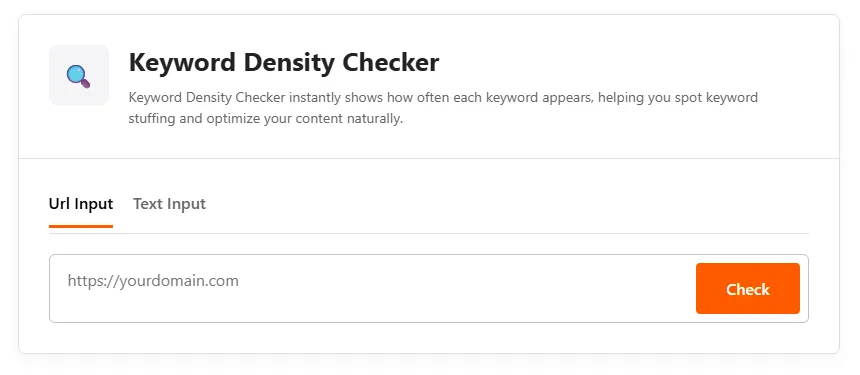
Step 1: Paste Your URL or Text
Just drop in your blog link, or paste your text directly. Hit Check.
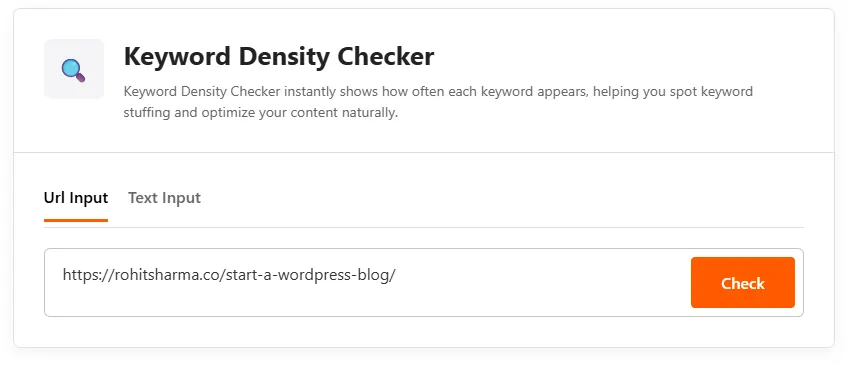
Step 2: Tool Reads Your Whole Content
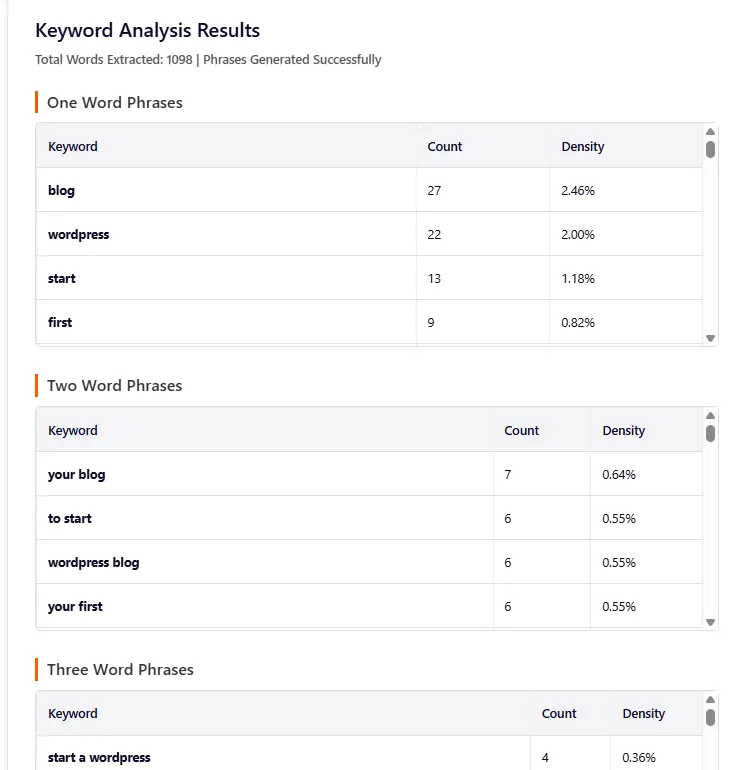
In a second, it counts every single word in your post. You’ll see the total at the top, something like “1098 words found.”
Step 3: Results Show Up in 3 Simple Boxes
This is the best part. Your results split into three easy sections:
- One Word Phrases — single words like “blog” or “wordpress”
- Two Word Phrases — pairs like “your blog” or “to start”
- Three Word Phrases — longer ones like “start a wordpress“
Each box has a small scroll bar, so you can see more results without the page getting messy.
Step 4: Check Count and Density
Every keyword shows two numbers next to it:
- Count — how many times that word or phrase showed up
- Density — what percentage of your total content that word makes up
So if “blog” shows up 27 times in a 1098-word post, you’ll see Count: 27 and Density: 2.46%. No math needed. The tool does it for you.
Step 5: Spot Problems Instantly
If one word looks too high compared to others, that’s your sign to fix it before you publish. Simple as that.
That’s it. No confusing dashboard, no extra steps. Paste, check, read your numbers, done.
How to Calculate Keyword Density Manually
You don’t need a PhD for this. The formula is dead simple:
(Number of times the keyword appears ÷ Total word count) × 100 = Keyword Density
Let’s run a real example. Say you wrote an 800-word blog post and used the phrase “keyword density checker” 10 times.
10 ÷ 800 = 0.0125
0.0125 × 100 = 1.25%
That’s your density. Right in the healthy zone, which we’ll get to in a second.
Here’s the part most guides skip: phrase length changes the math. A single word like “SEO” naturally repeats more than a four-word phrase like “free SEO text analyzer.” If you’re checking a long-tail phrase, expect the natural repetition count to be lower. That’s normal. Don’t force it higher just to hit a number.
This is exactly why typing your draft into an online keyword density tool beats doing it by hand every time. You can manually count one phrase, sure. But a proper keyword percentage calculator checks single words, two-word phrases, and three-word phrases all at once, and tells you instantly if anything looks inflated.
What’s the Ideal Keyword Density for Modern SEO?
If you want one number to remember: 1% to 2% is the safe zone.
Below 0.5%, your keyword might be too thin for Google to clearly understand your topic. Above 3%, you start raising flags for keyword stuffing, especially if that repetition feels unnatural to a reader.
But here’s the honest truth: density is a guideline, not a rule. A 2,000-word guide can naturally use a keyword 15 times and read perfectly fine. A 400-word page using the same keyword 15 times will sound robotic and repetitive, even if the math lands in a similar range.
Read your content out loud. If a phrase feels forced, it probably is, regardless of what the percentage says.
Google has been clear about this in its own spam policies for Google Search, which directly call out keyword stuffing as a manipulative practice that can hurt your visibility.
The Real Dangers of Keyword Stuffing
Keyword stuffing isn’t just an old-school mistake. It’s an active penalty risk.
Google runs what’s commonly called an over-optimization filter; an algorithmic check that looks for unnatural repetition patterns, awkward phrasing, and content that’s clearly written for a bot instead of a human. Trip that filter and your rankings can drop even if every other part of your SEO is solid.
Beyond rankings, stuffed content just reads badly. Visitors bounce. Time on page drops. Google notices that too.
Run your draft through a keyword stuffing finder before you hit publish. It takes less time than writing one more paragraph, and it can save you from a ranking drop you won’t notice until weeks later.
How to Fix Over-Optimized Content
- Swap repeats for synonyms. Instead of typing “keyword density checker” five times in a row, mix in “density analyzer” or “keyword frequency tool.”
- Add related terms naturally. Mention things like search intent, on-page SEO, or content optimization. These signal topical depth without repeating your main phrase.
- Re-check before publishing. Run the updated draft back through the tool above. Confirm your density landed in that 1-2% zone before you go live.
FAQs
What’s the ideal keyword density percentage?
Aim for 1% to 2%. Treat it as a guideline, not a strict rule. Readability always wins over hitting an exact number.
Does keyword density still matter for SEO in 2026?
Yes, but differently than before. It’s a diagnostic check to avoid stuffing, not a direct ranking booster.
Can keyword density actually hurt my rankings?
Yes. Repeating a phrase too often can trigger Google’s over-optimization filters and drag your rankings down.
How is keyword density different from keyword frequency?
Frequency is the raw count of how many times a word appears. Density is that count turned into a percentage of your total word count.
Should I check density before or after publishing?
Before. Catching stuffing in your draft takes thirty seconds. Fixing a ranking drop after the fact takes weeks.
Final Takeaway
Keyword density isn’t about hitting a magic number. It’s about writing naturally, checking your work, and catching problems before Google does.
Before you hit publish, run through this checklist:
- Density sits between 1% and 2%
- No single phrase repeats more than feels natural when read aloud
- You’ve used synonyms and related terms, not just exact-match repetition
- You’ve checked your draft using the tool at the top of this page
Five minutes with a proper checker beats five weeks of wondering why your traffic dropped.