Key Takeaways
- Content marketing is teaching, not pitching. You attract customers by solving their problems for free, rather than interrupting them with ads about your product.
- One good article works for years. Unlike paid ads that bring zero traffic the second you stop paying, a helpful article compounds in value over time, bringing in free leads months after you publish it.
- Random posting fails. You need a strategy that defines exactly who you are helping, what specific problem you are solving, and where they go to find answers.
- Match the content to the buyer’s stage. Beginners need educational guides. People ready to buy need comparisons and pricing details. If you only write beginner guides, you will never convert buyers.
- Use AI for speed, not for original thought. AI is an excellent research and outlining tool, but search engines only rank content that includes real, human experience and unique data that AI cannot invent.
Content marketing is the practice of creating and sharing valuable, free information to attract a specific audience, build their trust, and turn them into paying customers.
It works because it catches people when they are actively looking for a solution, rather than interrupting them while they are doing something else. You provide the answer to their problem. In return, they pay attention to your business.
Most businesses fail at content marketing because they treat it like a diary. They write about their company, their products, and their awards. Then they wonder why nobody reads it.
This guide is different. It will show you exactly how to plan, create, and measure content that actually brings in customers, even if you are starting from zero.
In this guide, you will learn:
- How to stop pitching and start helping
- The three rules that make content drive sales
- A step-by-step method to build a strategy this week
- How to match your content to exactly where the customer is in their buying journey
- The right way to use AI without hurting your search rankings
- The specific numbers you need to track to prove your content is making money
The Truth About Content Marketing
Why most businesses get content marketing wrong
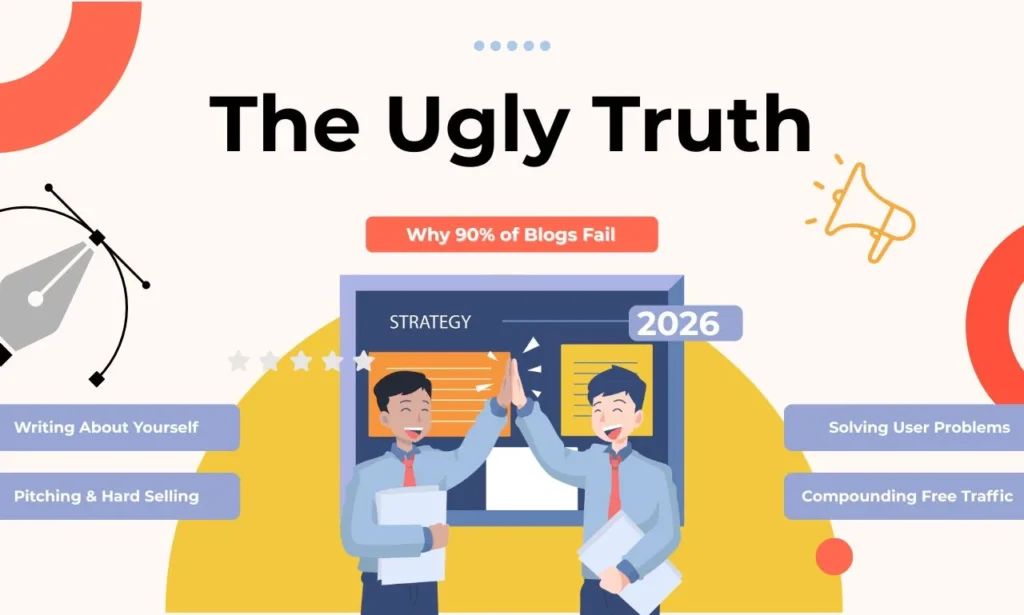
The fastest way to kill your content’s performance is to make it about you.
Traditional marketing says: “Look at our great product, buy it now.”
Content marketing says: “Here is the solution to the problem you are stressing over right now.”
When you publish a post titled “Why Our Software is the Best,” you are pitching. Nobody searches for that. When you publish a post titled “How to Cut Your Monthly Accounting Time in Half,” you are helping. Thousands of people search for that.
Content marketing is teaching your audience how to solve their problems. When they finally need a tool or a service to do it faster, they hire you because you have already proven you know what you are doing.
A simple content marketing example
Imagine you own a local landscaping company.
Pitching looks like a Facebook ad that says, “We offer the best lawn care in town! 20% off your first mow!”
Content marketing looks like a blog post on your website titled, “Why Your Grass Turns Brown in Summer (And How to Fix It).”
A homeowner types that exact question into Google. They find your article. They read your free advice on watering schedules and fertilizer. They realize you actually know what you are talking about. When their sprinkler breaks, they don’t search Google again, they click the “Contact Us” button on your site.
The same logic applies to B2B companies. If you sell project management software, you don’t write about your new dashboard feature. You write “How to Stop Missing Project Deadlines: A 5-Step Framework.” The project managers who read it will remember your brand when their boss asks them to find a better tool.
How Content Marketing Actually Works (The Three Rules)
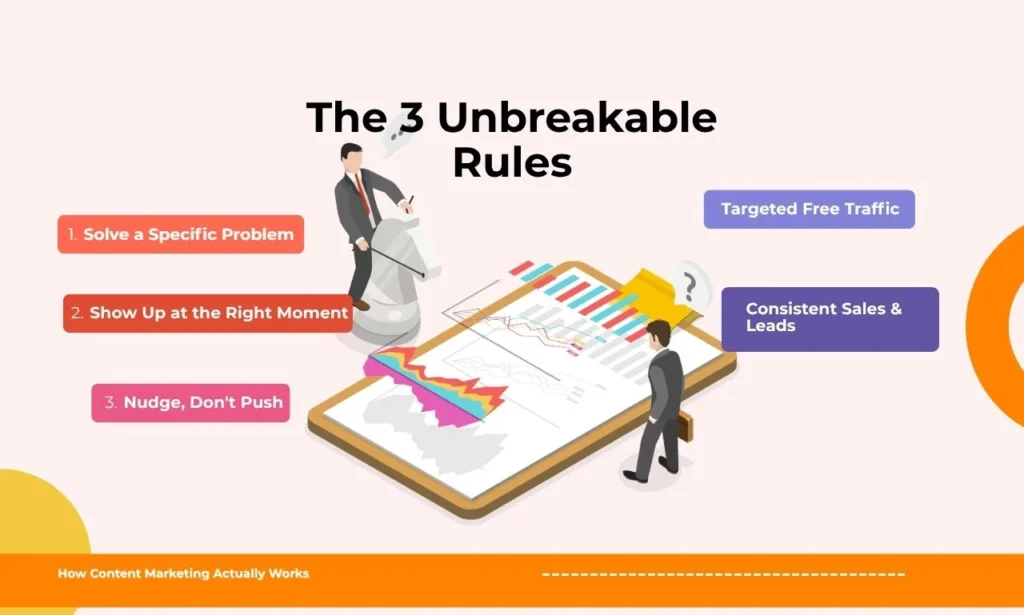
Not all content drives business. Most of it is just noise. The content that actually generates leads and sales consistently does three things:
Rule 1: Solve a specific problem
General advice is useless. “How to get fit” is too broad. “A 4-week walking plan for beginners with bad knees” solves a specific problem for a specific person.
Search engines and AI models prefer specific, detailed content because it directly answers the user’s exact query. If you try to write for everyone, you appeal to no one. Pick one narrow problem and solve it completely.
Rule 2: Show up at the exact right moment
Content marketing is a timing game.
If someone is just realizing they have a problem, they ask “What is [Problem]?”
If they know the problem and are looking for solutions, they ask “What are the best tools for [Problem]?”
If they are ready to buy, they ask “[Your Competitor] vs. [Your Brand] pricing.”
Your content needs to be waiting at each of those stops. If you only write basic beginner guides, you capture people at the start of their journey, but you have nothing to offer them when they are ready to pull out their credit card.
Rule 3: Nudge, don’t push
If someone reads your article and feels like they just sat through a sales pitch, you lost.
Good content ends with a logical next step. If you just taught someone how to organize their taxes, the logical next step is not “Buy our software now.” The logical next step is, “If you want to automate the spreadsheet we just built, here is a free template that does it for you.”
You trade an email address for the template. Now they are on your list. You have nudged them closer to a sale without ever sounding like a salesperson.
How to Build a Content Marketing Strategy in 5 Steps
Most content fails before it is published because there is no strategy behind it. You sit down, write a post about whatever is on your mind, hit publish, and check your analytics a week later to find out three people read it.
Here is how to build a content strategy that actually drives traffic.
Step 1: Who exactly are you trying to help?
Do not start with demographics. “Men aged 35-55” is a terrible way to define an audience because two 40-year-old men might have completely different problems.
Start with the problem by choosing the right blog niche. Who is the person who desperately needs the information you have?
Write down:
- Their job title or life situation
- The specific problem they are losing sleep over
- What happens if they don’t fix the problem
If you sell email marketing software, your audience is not “marketers.” Your audience is “freelance agency owners who are losing clients because their weekly newsletters keep landing in spam folders.” Be that specific.
Step 2: What do you want them to do?
“Build brand awareness” is not a goal. It is a wish. You cannot measure a wish.
Choose a quantifiable goal.
- “Get 200 new email subscribers this month.”
- “Generate 50 demo requests from organic search this quarter.”
- “Rank on page one of Google for [Specific Keyword].”
When you know exactly what action you want the reader to take, you can reverse-engineer the content. If your goal is demo requests, your content needs to focus on the limitations of doing things manually, pushing them toward needing a tool.
Step 3: Where should you publish?
You do not need to be on every blogging platform. You need to be where your specific audience spends their time.
- A company blog: Essential for SEO. This is your permanent storefront. It is where you publish the detailed guides that rank on Google.
- Short-form video (TikTok, Instagram Reels, YouTube Shorts): Best if your audience is under 35 or your product is highly visual.
- LinkedIn: Best for B2B, SaaS, or targeting high-level decision-makers.
- Email: Not a discovery platform, but the place where you turn readers into buyers.
If you run a B2B software company, your primary channel is your blog for Google search, supplemented by LinkedIn to distribute your articles. Pick one or two channels. Master them. Only expand once they are consistently bringing in traffic.
Step 4: What should you say, and when?
An editorial calendar is like a meal plan for your content. Without it, you stare at a blank screen on Tuesday morning and end up writing something irrelevant just to hit a deadline.
Plan your topics a month in advance.
- List 4 to 8 questions your audience searches for (use free tools like Google’s “People Also Ask” section to find these).
- Assign one question to each week.
- Decide the format (e.g., Week 1: How-to guide. Week 2: Comparison post).
Consistency beats volume (according to annual blogger statistics, regular publishers see drastically stronger results). Publishing one helpful article every single week for a year will drastically outperform publishing five articles in one week and then vanishing for a month. Search engines reward sites that show consistent, reliable publishing habits.
Step 5: How do you get people to read it?
Hitting “publish” does not mean your work is done. It means your work has just started. Distribution is how content gets found.
If you write a blog post, don’t just share the link on Twitter once.
- Break the post into a 5-slide LinkedIn carousel.
- Pull one key insight and turn it into a short video.
- Send a summary of the post to your email list with a link to read the full article.
Put your content in the format your audience prefers. If they love reading, give them the article. If they prefer watching, give them the video.
Only pay to promote content after it has proven it can get organic engagement. If a post gets zero likes and zero shares organically, paying for ads will just waste money. If a post gets unusually high organic engagement, put ad spend behind it to multiply the results.
How to Match Your Content to the Buyer Journey
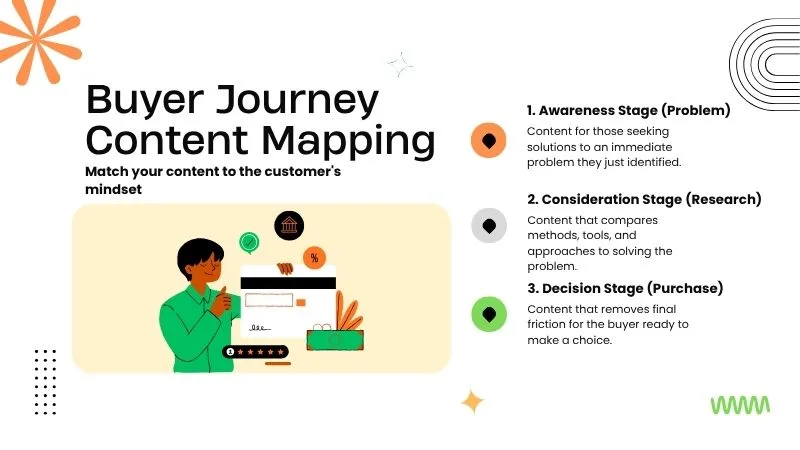
A common beginner mistake is writing only basic, introductory content and wondering why nobody buys. You are catching people at the starting line, but you have no content to guide them to the finish line.
You need different types of content for different stages of the buyer’s journey.
How do you create content for the Awareness stage?
At this stage, the person knows they have a problem, but they don’t know how to fix it. They are asking broad “How to…” and “What is…” questions.
Your content: Comprehensive, educational guides.
Example: “What is Content Marketing? A Complete Beginner’s Guide.”
Why it works: This format is exactly what search engines and AI models look for when answering general knowledge questions. If you write a clear, step-by-step guide here, you win the first interaction.
How do you create content for the Consideration stage?
Now the person knows how to fix their problem, and they are researching different methods or tools. They are asking “Best tools for…” or “X vs. Y” questions.
Your content: Comparison posts, listicles, and case studies.
Example: “HubSpot vs. ActiveCampaign: Which is Better for Small Agencies?”
Why it works: The reader is already educated. They just need to know why they should pick you over your competitor. A fair, honest comparison builds massive trust. (Do not just write a hit piece on your competitor; highlight where they win, but show where you excel).
How do you create content for the Decision stage?
The person has their credit card out. They just need a final push to feel safe making a decision.
Your content: Detailed pricing pages, ROI calculators, and technical documentation.
Example: “How to Migrate to [Your Software] in Under 10 Minutes.”
Why it works: It removes the last bit of friction. You are proving that choosing you is easy, safe, and fast.
How to Use AI in Content Marketing (Without Ruining Your Brand)

Almost everyone is using AI to write content now. Because of this, AI-generated content is flooding the internet. Search engines are actively penalizing generic, unedited AI content because it offers no new information.
Here is how to use AI to speed up your work without destroying your search rankings.
What AI is actually good at
Think of AI as a fast research assistant, not a writer.
- Research: Ask AI to summarize 10 recent articles about a topic so you don’t have to read them all.
- Outlining: Give AI your topic and ask it to generate a structural skeleton.
- Repurposing: Paste your finished blog post into AI and ask it to rewrite it as a 5-part email sequence.
In all of these cases, the original thinking is still yours. AI is just doing the tedious formatting work.
Where AI will hurt your rankings
AI models do not have real-world experience. They only know what has already been published on the internet.
If you ask AI to “write a blog post about email marketing,” it will give you a regurgitated list of tips like “write a catchy subject line” and “segment your list.” Google has seen that exact article ten million times. It will not rank.
Search engines now prioritize “Information Gain”, meaning your content must contain something that is not already on the first page of Google. AI cannot generate Information Gain. Only your firsthand experience can.
A real example of using AI the right way
Let’s say you want to write an article on reducing cart abandonment.
Do not do this: “Write a 1,000-word blog post on reducing cart abandonment.” (Result: Generic fluff).
Do this instead:
- You write the core insight: “Last month, we moved our checkout button above the fold on mobile, and cart abandonment dropped by 14%.”
- You ask AI: “Turn this data point into a 3-paragraph case study structure.”
- You edit the output: You add the exact screenshots from your analytics dashboard and rewrite the AI’s robotic tone to sound like a human explaining a win to a colleague.
The article now ranks because it contains a real, specific data point that no AI could have invented.
How to Measure Content Marketing Success
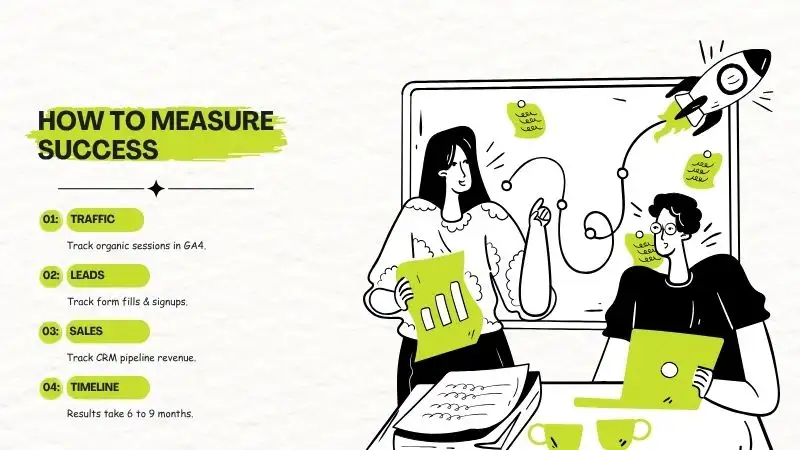
Page views and social media likes are vanity metrics. They feel good, but they do not pay your bills.
To know if your content is actually working, you must tie it directly to business outcomes. Here is a simple framework to measure your success.
The metrics that actually matter
Map your content metrics directly to the goal you set in Step 2.
- If your goal is traffic: Track organic sessions to your blog posts using Google Analytics 4 (GA4). A healthy baseline for a new site is seeing traffic double every 3 to 6 months.
- If your goal is leads: Track conversions (form fills, demo requests, or email signups) specifically attributed to your content pages.
- If your goal is sales: Track pipeline revenue. Most CRM tools (like HubSpot or Salesforce) can track if a closed-won deal originally came from a specific blog post.
If you cannot draw a straight line from a piece of content to a lead or a sale, you cannot prove its value.
When will content marketing start working?
Content marketing is a compounding asset, not a paid ad.
When you turn off a Facebook ad, the traffic drops to zero immediately. When you publish a great blog post, it might bring in 10 visitors a month in month one. But in month six, it might bring in 100. In month twelve, it might bring in 500.
For most businesses, it takes 6 to 9 months of consistent, high-quality publishing before you see a meaningful spike in organic traffic and leads. If you quit after two months because “it’s not working,” you are throwing away the foundation you just built.
FAQs About Content Marketing
What is content marketing?
Content marketing is creating and sharing free, valuable information (like articles, videos, or emails) to attract a specific audience and turn them into customers, rather than paying for ads to interrupt them.
Why is content marketing better than paid advertising?
Paid ads stop bringing in traffic the second you stop paying for them. A well-written piece of content can rank on search engines and bring in free, highly targeted traffic for years.
How much does content marketing cost?
It can cost as little as your time if you write it yourself. If you hire freelance writers, expect to pay $200 to $1,000+ per in-depth article. The ROI typically outweighs the cost because the asset works for you long-term.
How long does it take for content marketing to work?
Most businesses start seeing meaningful organic traffic and lead generation after 6 to 9 months of consistent publishing. It requires patience because search engines take time to trust new websites.
What is the difference between content marketing and social media marketing?
Social media marketing is the distribution of content on platforms like LinkedIn or Instagram. Content marketing is the creation of the strategy and the content itself (which can include blog posts, podcasts, or emails, not just social posts).
Do you need a blog to do content marketing?
A blog hosted on your own website is the most effective format for content marketing because it builds your domain’s search engine authority. However, you can use video channels like YouTube as your primary “blog” if your audience prefers video.
How do you measure content marketing ROI?
By tracking how many leads or how much revenue can be directly traced back to your content. You do this by tracking form submissions on blog pages or using CRM software to see which articles closed-won customers read before buying.
Is AI going to replace content marketers?
No. AI is a tool that speeds up research and formatting, but it cannot generate original experiences, unique data, or human empathy. The most successful content marketers use AI to work faster, not to do the thinking for them.
What makes a piece of content “good”?
Good content solves one specific problem completely. It uses simple language, includes real-world examples or data, and gives the reader a clear, actionable next step without making them feel pressured to buy.
How do you come up with content ideas?
Type your topic into Google and scroll to the bottom to see the “People Also Ask” questions. Look at the subheadings of top-ranking articles to find gaps they missed. Ask your customer service team what questions they get asked every day.
Conclusion
You publish a piece of content. At first, crickets. But because you solved a specific problem, search engines eventually find it. A frustrated person types their exact problem into Google. Your article pops up.
They read it. They realize you understand their struggle. They click the link at the bottom to see how your service can help them do it faster. They become a customer.
That is what content marketing does when you stop writing about yourself and start writing for your reader.
Pick one step from this guide today. Define exactly who you are trying to help, or write down three specific problems they have. Build your strategy around those answers, publish consistently, and give the compounding effect time to work.