Content strategy is the foundation of every successful digital marketing effort that helps you create content with purpose instead of posting randomly.
Have you ever published blog posts or social media content but still didn’t get traffic, leads, or sales?
That’s because most people create content without a proper content strategy.
A content strategy is not just about writing blog posts or posting on social media. It is a planned system that helps you create the right content for the right audience at the right time. It ensures your content is aligned with your business goals, improves visibility on search engines, and helps you reach the right potential customers.
Without a clear strategy, even high-quality content creators end up wasting time creating random content that does not bring results. But with a proper plan, every piece of content works together to increase organic traffic, build brand awareness, and support your full content marketing strategy.
In this guide, you will learn step-by-step how to build a powerful content strategy from scratch – in a simple, beginner-friendly way. You will understand how to find your target audience, plan your content creation, use an editorial calendar, and optimize your content for better performance on search engines.
Also, check: Build a Beautiful Website with Free WordPress Themes
What is Content Strategy?
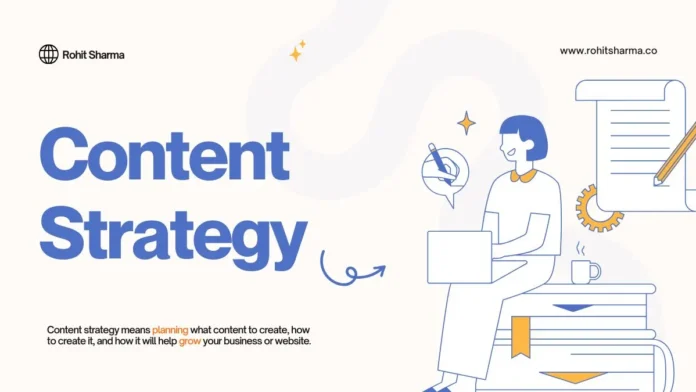
A content strategy is a planned approach to creating, managing, and distributing content that helps you achieve your business goals and reach the right target audience.
In simple words, it is a system that tells you:
What content to create
Why are you creating it
Who are you creating it for
How it will help your business grow
Instead of randomly publishing blog posts or social media updates, a content strategy ensures every piece of content has a clear purpose and supports your overall content marketing strategy.
A good content strategy connects your content creation with real outcomes like:
- Increasing organic traffic from search engines
- Improving brand awareness
- Attracting potential customers
- Guiding users through the buyer’s journey
It is usually planned by a content strategist or content team, so that all content creators work in the same direction and align with your brand message.
Without a content strategy, content becomes random.
With a content strategy, content becomes a growth system.
Simple Example
If your business wants more leads, you don’t just write random blog posts.
Instead, you plan:
- Awareness blog posts (educational content)
- Comparison posts (help users decide)
- Conversion content (product/service pages)
This structured planning is what makes content effective.
In Short
Content strategy =
“Planned content that helps the right audience and drives business results.”
Why Content Strategy is Important
A content strategy is important because it turns random content creation into a structured system that actually delivers results for your business.
Without a strategy, most content creators publish blog posts or social media content without direction. As a result, the content does not reach the right target audience, does not attract potential customers, and fails to generate meaningful organic traffic from search engines.
But when you have a clear content strategy, every piece of content works with a purpose. It supports your business goals, improves visibility on search engines, and strengthens your overall content marketing strategy.
Key Benefits of Content Strategy
1. Helps You Achieve Business Goals
A content strategy ensures your content is aligned with your business goals, whether it is sales, leads, or brand growth.
2. Increases Organic Traffic
Well-planned content improves ranking on search engines, bringing consistent organic traffic to your website.
3. Builds Brand Awareness
Consistent and valuable content helps increase brand awareness and makes your business more recognizable.
4. Targets the Right Audience
It helps you understand your target audience and create content that solves their real problems.
5. Supports the Buyer’s Journey
A good strategy guides users step-by-step through the buyer’s journey, from awareness to decision-making.
6. Improves Content Team Efficiency
It helps content teams and content creators stay organized with a clear plan instead of guessing what to create next.
Simple Meaning
Without a strategy → random content, no results
With strategy → planned content, real growth
Content Strategy vs Content Creation
Building a high-authority digital presence in 2026 requires a perfect synergy between the blueprint and the build. Here is the breakdown of Content Strategy vs. Content Creation optimized for modern search and generative engines.
Content Strategy (The Planning Stage)
Content strategy is the high-level roadmap that aligns your content marketing effort with specific business goals. It isn’t about writing; it’s about deciding why you are writing and who you are writing for.
A content strategist analyzes the target audience to map out the buyer’s journey, ensuring every piece of content serves a purpose – whether it’s capturing organic traffic or converting potential customers.
- Goal: Topical authority and sustainable ROI.
- Focus: Competitive analysis, keyword mapping (SEO/AEO), and distribution channels.
- Deliverable: Content calendars, site architecture, and performance audits.
Content Creation (The Execution Stage)
Content creation is the tactical process of generating the actual assets. This is where content creators take the strategic brief and turn it into blog posts, social media updates, or interactive tools.
While strategy asks “What should we rank for?”, creation asks “How do we make this the best result on search engines?” It involves the craft of writing, designing, and coding to ensure the user stays on the page.
- Goal: High engagement and user satisfaction.
- Focus: Readability, storytelling, and technical optimization (AIO/EEAT).
- Deliverable: The final article, video, or utility tool.
Key Difference (Very Important)
The fundamental difference lies in Intent vs. Output.
| Feature | Content Strategy | Content Creation |
| Question | “Why are we making this?” | “What are we making?” |
| Driver | Data and Research. | Creativity and Craft. |
| Success | Domain growth and lead gen. | Time-on-page and shares. |
| Analogy | The Architect (The Blueprint). | The Builder (The House). |
Real Example (Easy to Understand)
Imagine you are launching a content marketing strategy for a “Python Coding” blog.
- The Strategy: After researching the target audience, the strategist realizes there is a gap in “Simple Calculators.” They decide to create a topic cluster around “Python Tools” to boost organic traffic. They plan 10 blog posts and one interactive script.
- The Creation: The creator then sits down to create content. They write a 1,500-word guide on “How to build a calculator,” ensuring it includes a clean code block, a direct answer for search engines (AEO), and unique insights (GEO) to stand out.
In Short
Content Strategy finds the opportunity and sets the rules, while Content Creation executes the vision to provide value to the user. Without a strategy, you are “shooting in the dark”; without creation, you have no “bullets.” To win in 2026, your strategy must be data-driven (AIO), and your creation must be human-centric (EEAT).
Understanding Your Target Audience

To build a successful digital presence, you must move beyond generic traffic and focus on the specific people who will actually interact with your brand. Understanding your target audience is the bridge between a website that just exists and one that converts.
Why Audience Research Matters
Researching your audience is the first step in any successful content plan. If you don’t know who your readers are, your content will be too broad to be useful. Research helps you identify the specific pain points of your potential customers, allowing you to create solutions instead of just “content.”
Without this data, content creators are essentially guessing what will work, which leads to high bounce rates and low authority on search engines.
Who Your Readers Are
Defining your audience goes beyond basic demographics like age or location. You need to understand their intent and their behavior.
- Professionals vs. Hobbyists: Is your reader an SEO expert looking for technical documentation, or a beginner looking for a “how-to” guide?
- Information Seekers vs. Buyers: Are they just browsing for knowledge, or are they ready to download a tool or purchase a service?
- Device Habits: Do they read long-form articles on desktops or look for quick answers on mobile while on the go?
What Problems Do They Have
The most successful content solves a problem. Your audience isn’t searching for keywords; they are searching for solutions.
- Pain Points: What is stopping them from achieving their goals? (e.g., “My website is slow,” or “I can’t generate a UPI QR code.”)
- Desired Outcomes: What does success look like for them?
- Barriers: Why haven’t they solved this problem yet? Is it a lack of technical skill, time, or the right tools?
What They Search on Search Engines
Once you know their problems, you can predict their search behavior. This is where you align your content with their natural language.
- Informational Queries: “What is…” or “How to…”
- Navigational Queries: Searching for a specific site or tool.
- Transactional Queries: “Best SEO tool 2026” or “Download Pinterest video.”
By mapping these queries, you ensure that when potential customers turn to search engines, your site appears as the authoritative answer.
The Buyer’s Journey
The buyer’s journey is the process every user goes through before making a decision. Your content must support them at every stage:
- Awareness Stage: The user realizes they have a problem (e.g., “Why is my site not indexing?”).
- Consideration Stage: The user starts looking for specific types of solutions (e.g., “Google Search Console errors guide”).
- Decision Stage: The user chooses a specific tool or method to fix the issue (e.g., “Using an Indexing API tool”).
In Short
Knowing your target audience means you stop writing for everyone and start writing for the right person. By focusing on their specific problems and their path through the buyer’s journey, you build a loyal reader base that trusts your expertise and returns to your site.
Do you have a specific niche in mind where you want to apply this audience research?
Also, check: This Simple Formula Can Help You Pick the Right Niche
Setting Business Goals for Content Strategy
To ensure your content marketing effort delivers more than just “empty metrics,” you must anchor every piece of content to a specific business outcome. Without clear objectives, your site might get visitors, but it won’t generate value.
How Content Connects to Business Results
A successful content marketing strategy acts as a bridge between a user’s problem and your business solution. Every article or tool on your site should have a “job to do.” If a post doesn’t move a user closer to a business goal, it is essentially a wasted resource.
- Attraction: Using high-value information to pull people in.
- Education: Building trust by solving small problems for free.
- Conversion: Steering the user toward a sign-up, a download, or a purchase.
Setting KPIs (Key Performance Indicators)
You cannot manage what you do not measure. To see if your content strategy is working, you need to track specific metrics that align with your business goals.
| Goal | Primary KPI | Secondary KPI |
| Growth | Organic traffic (Users/Sessions) | Keyword rankings (Top 3 positions) |
| Visibility | Increase brand awareness (Impressions) | Social shares and mentions |
| Lead Gen | Conversion rate (Sign-ups/Forms) | Click-through rate (CTR) on CTAs |
| Authority | Average session duration | Returning visitor rate |
Aligning Content with Goals
Not all content is created equal. Your strategy must balance different types of content to satisfy various business goals:
1. Traffic Drivers (The Volume)
- Goal: Maximize organic traffic.
- Content: Viral news, broad “what is” guides, and high-volume trend reports.
- Focus: Casting a wide net to get your brand in front of as many eyes as possible.
2. Authority Builders (The Trust)
- Goal: Increase brand awareness and establish expertise.
- Content: White papers, original case studies, and deep-dive technical tutorials.
- Focus: Proving to both users and engines that you are a leader in your niche.
3. Conversion Assets (The Revenue)
- Goal: Direct business results and lead generation.
- Content: Product comparisons, “best of” lists, and interactive calculators or tools.
- Focus: Helping the user make a final decision that benefits your bottom line.
In Short
Setting business goals ensures that your content marketing strategy is a calculated investment rather than a shot in the dark. By aligning every content marketing effort with a measurable KPI, you transform your website from a simple blog into a powerful engine for growth.
Types of Content You Should Create
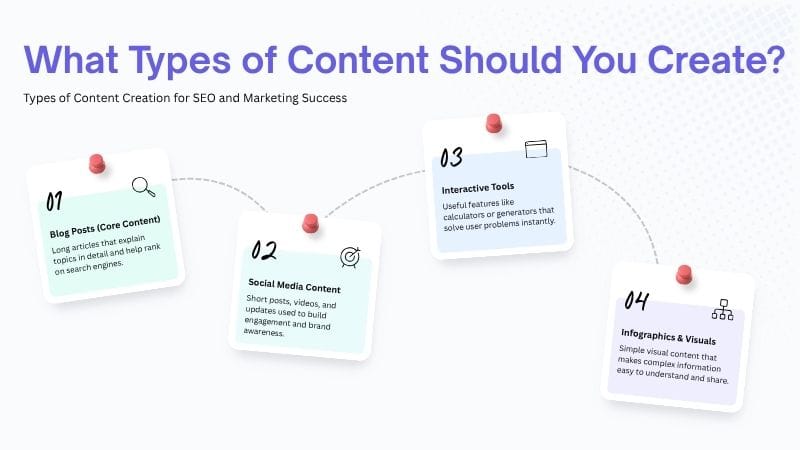
The art of content creation lies in matching the right format to the user’s intent. Not every piece of content needs to be a long essay; sometimes, a quick tool or a visual guide is what the user actually needs to solve their problem.
Popular Formats for Content Creation
As content creators, you have a variety of tools at your disposal. Choosing the right one depends on where your audience is and what they are looking for.
1. Blog Posts & Articles (The Foundation)
Blog posts are the backbone of most websites. They are perfect for deep dives, tutorials, and answering complex questions.
- When to use: To rank for long-tail keywords and provide detailed value.
- Example: “A Complete Guide to Python Calculators 2026.”
2. Social Media Content (The Hook)
Social media is where you build a community and drive immediate traffic. These are shorter, punchier versions of your main ideas.
- When to use: To increase brand awareness and engage with users in real-time.
- Example: A 30-second video on Instagram or a Twitter thread summarizing a new industry trend.
3. Utility Tools & Interactive Content (The Value)
Sometimes, the best way to create content isn’t through words, but through functionality. Interactive tools keep users on your site longer (improving dwell time).
- When to use: To solve a specific, repetitive task for your user.
- Example: A UPI QR Code Generator or an SEO Meta Tag Checker.
When to Use What Format?
| Format | User Intent | Best Platform |
| Long-form Blog | Information & Education | Website (CMS) |
| Infographics | Quick Visual Summary | Pinterest / LinkedIn |
| Short-form Video | Entertainment & Awareness | TikTok / Reels / Shorts |
| Interactive Tool | Problem Solving | Custom Web Page |
Strategic Content Mix
A smart content creation plan doesn’t just stick to one type. You should “repurpose” your assets to maximize their reach:
- Start with a deep-dive piece of content (like a technical guide).
- Break it down into three social media posts.
- Turn the core data into an infographic.
- Build a small tool that automates the process described in the article.
In Short
To create content effectively, you must think beyond the text. By diversifying your formats – from blog posts to social media – you ensure that your brand is present wherever your audience spends their time.
Content Planning with Editorial Calendar

Consistency is the secret sauce of any high-growth digital platform. Without a structured planning system, content creation becomes reactive rather than proactive. An editorial calendar is the central nervous system that keeps your strategy on track.
The Purpose of a Planning System
An editorial calendar is more than just a list of dates. It is a strategic tool used by content teams to visualize the entire content pipeline. It ensures that you aren’t just publishing for the sake of it, but that every piece of content aligns with your seasonal goals or industry trends.
- Avoids Last-Minute Stress: You always know what is being worked on next.
- Ensures Topic Diversity: It prevents you from repeating the same topics too often.
- Aligns Resources: It helps developers (for tools) and writers (for blogs) stay synchronized.
Must check: Improve Your SEO With These Backlink Checker Tools
Building Your Publishing Schedule
To create content that actually ranks and builds authority, you need a predictable rhythm. Your schedule should be realistic based on the size of your team.
The 3-Tier Planning Model:
- Annual/Quarterly Themes: High-level goals (e.g., “Q1: Technical SEO Focus”).
- Monthly Roadmap: Specific topics, keywords, and assigned content creators.
- Weekly Task List: The granular steps of content creation, including drafting, coding custom HTML blocks, and final SEO checks.
Elements of an Effective Calendar
A professional-grade editorial calendar should track more than just titles. It should include:
- Target Persona: Who is this specific post for?
- Primary Keyword: The core focus for search engines.
- Status: (e.g., Ideas, Researching, Drafting, Ready, Published).
- Distribution Plan: Where will this be shared (Social Media, Newsletter, etc.)?
Consistency vs. Frequency
Many content teams make the mistake of choosing quantity over quality. It is better to create content once a week that is deeply researched and technically optimized than to post five times a week with “fluff” articles.
Consistency builds a “habit” for both your users and search crawlers. When Google knows you update every Tuesday, it prioritizes crawling your site more efficiently.
In Short
An editorial calendar transforms a chaotic “what should I write today?” mindset into a professional publishing powerhouse. It is the roadmap that ensures your content creation efforts lead directly to your long-term business goals.
Content Creation Process (Step-by-Step)
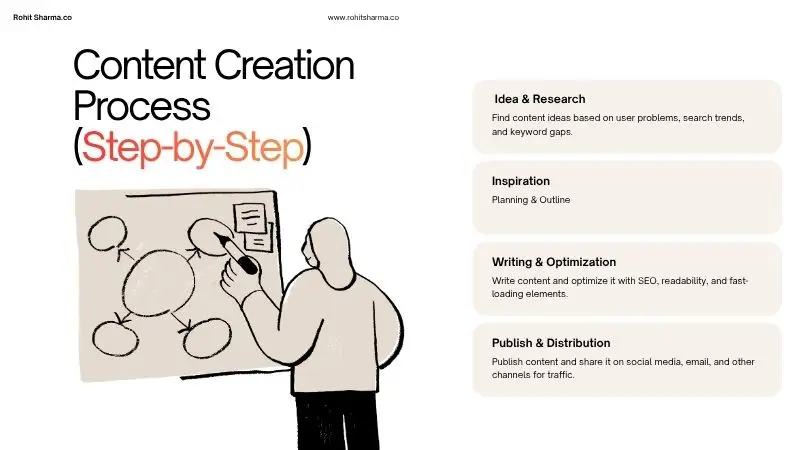
A professional content creation workflow transforms a raw idea into a high-ranking asset. For content creators, having a repeatable system ensures that every piece of content maintains a high standard of quality and technical performance.
The Idea to Publish Workflow
Step 1: Ideation & Research
Every great piece of content starts with a problem to solve. Use data from search trends and competitor gaps to find a unique angle.
- Focus: Is there a “missing tool” or an unanswered question in this niche?
Step 2: The Brief & Outline
Before you create content, build a skeleton. Define your H1, H2, and H3 tags. This ensures the logical flow of information and makes it easier for both humans and AI engines to parse.
Step 3: Drafting & Development
This is the core of content creation.
- For Writers: Focus on clarity, personal experience, and direct answers.
- For Developers: Code the custom HTML blocks or interactive scripts that add functional value to the page.
Step 4: Technical Optimization (The “Polish”)
To truly create content that ranks in 2026, you must optimize for performance:
- Image Compression: Ensure all visuals are lightweight.
- Code Minification: Keep your scripts clean to maintain fast loading speeds.
- Internal Linking: Connect the new post to your existing “Topic Clusters.”
Step 5: Review & Formatting
A second pair of eyes (or a solid AI check) is vital. Look for readability issues, broken links, or blocks of text that are too dense. Use bullet points and tables to make the piece of content scannable.
Step 6: Publishing & Distribution
Once live, the job of content creators isn’t over. You must distribute the asset across your newsletter and social channels to kickstart the initial traffic.
Content Creation Checklist
- [ ] Does the headline spark curiosity?
- [ ] Is there a direct answer at the top?
- [ ] Are all custom code blocks functional and fast?
- [ ] Does it provide “Information Gain” (something new)?
In Short
The content creation process is a balance of creativity and technical discipline. By following a structured step-by-step workflow, you ensure that every piece of content you produce is an asset that builds long-term authority.
Content Distribution Strategy
Creating a high-quality piece of content is only half the battle. The other half is ensuring it actually reaches your audience. A robust distribution strategy is what transforms a quiet blog post into a high-traffic asset, ensuring your content marketing effort isn’t wasted.
How Content Reaches Users
Content doesn’t just “find” an audience; you must place it where they already spend their time. Distribution can be broken down into three main pillars: Owned (your site/email), Earned (social shares/PR), and Paid (ads).
By diversifying how you distribute blog posts, you reduce your reliance on a single platform and build a more resilient traffic ecosystem.
The Three Pillars of Distribution
1. Search Engines (The Long-Term Engine)
Optimizing for search engines is the most effective way to generate consistent, long-term organic traffic.
- Strategy: Focus on “Search Intent.” If a user searches for a tool, ensure your page loads instantly and provides the utility they need.
- Technical Tip: Use internal linking to pass “link juice” from high-authority pages to new content.
2. Social Media (The Amplification Engine)
Social media is perfect for immediate feedback and “viral” potential. It helps increase brand awareness by putting your content in front of people who aren’t actively searching but are interested in your niche.
- Strategy: Don’t just post a link. Create a “native” summary – a thread on X (Twitter), a carousel on LinkedIn, or a short video for Reels – that encourages users to click through to your site for the full details.
3. Email Marketing (The Retention Engine)
Your email list is the only distribution channel you truly own. It is the most direct way to bring potential customers back to your site.
- Strategy: Send a weekly digest of your best blog posts or exclusive “subscribers-only” tools. This creates a recurring loop of organic traffic that doesn’t depend on algorithm changes.
The Distribution Workflow
To maximize your content marketing effort, follow this “Create Once, Distribute Everywhere” (COPE) model:
- Publish: Launch the main blog post on your website.
- Notify: Send an automated email to your subscribers.
- Socialize: Share a “hook” or a key insight on social media with a link to the full article.
- Repurpose: Turn the core data into an infographic or a 60-second video for different platforms.
In Short
Distribution is the “marketing” in content marketing strategy. By balancing the long-term power of search engines with the immediate reach of social media, you ensure your content consistently reaches the right eyes.
SEO in Content Strategy
Integrating SEO into your content strategy ensures that your website isn’t just a collection of blog posts, but a structured map that search engines can easily understand and rank. SEO is the “discovery layer” that connects your expertise with the users who are actively looking for it.
Also, check: Looking for an SEO Expert in Raipur? Start Here
SEO Basics Inside Strategy
A data-driven content strategy treats SEO as a foundational requirement, not an afterthought. Instead of writing a post and then “adding keywords,” a strategic approach starts by identifying the high-value topics that will drive consistent organic traffic.
- Topic Clusters: Grouping related blog posts around a central “pillar” page. This signals to search engines that you have deep authority on a specific subject.
- Search Intent: Mapping each content piece to what the user actually wants – whether it’s a quick answer, a detailed tutorial, or a specific tool.
Key Ranking Factors for 2026
To win in the modern search landscape, your strategy must account for both technical and behavioral factors:
- Technical Health: Search engines prioritize sites that are fast, secure (HTTPS), and mobile-friendly. A clean site architecture allows crawlers to index your content more efficiently.
- User Engagement (Dwell Time): If users stay on your page to use a tool or read a long-form guide, it signals to algorithms that your content is high-quality.
- Semantic Relevance: Modern search looks for “entities” and context, not just exact-match keywords. Your keyword usage should be natural and cover synonyms and related subtopics.
The Optimization Workflow
Inside a professional content strategy, every piece of content follows a specific optimization checklist:
- On-Page SEO: Crafting compelling Meta Titles and Descriptions to improve Click-Through Rate (CTR).
- Header Hierarchy: Using
<h1>through<h3>tags to organize information for both readers and crawlers. - Image Optimization: Using descriptive ALT text and modern formats (like WebP) to ensure accessibility and speed.
- Internal Linking: Strategically linking new blog posts to older, high-authority pages to distribute “link equity” across the site.
Why SEO and Strategy Must Align
Without a clear content strategy, your SEO efforts will be fragmented. You might rank for random keywords that don’t bring in potential customers. By aligning the two, you ensure that every spike in organic traffic contributes directly to your long-term business goals.
In Short
SEO is the engine of your content strategy. By focusing on technical excellence, topic authority, and user intent, you create a sustainable flow of visitors from search engines that grows over time.
Improving Existing Content
Creating new content is exciting, but some of your biggest wins in organic traffic come from optimizing what you already have. Updating existing content is often faster and more effective than starting from scratch because the page already has age and authority in the eyes of search engines.
Why You Should Refresh Old Content

Over time, even the best blog posts can lose their rankings. This is known as “content decay.” Information becomes outdated, links break, and competitors publish newer, more comprehensive guides.
By strategically improving existing content, you signal to search engines that your site is active, accurate, and committed to providing the best possible user experience.
The Content Audit Workflow
1. Identify “Low-Hanging Fruit”
Use search data to find pages that are ranking on page 2 (positions 11–20). These are your best candidates for a refresh because a few small tweaks can push them onto page 1, significantly increasing your organic traffic.
2. Update Facts and Data
Ensure all statistics, dates, and references are current. If a post says “Best Tools for 2024,” update it to “2026” and verify that the tools mentioned are still relevant and functional.
3. Improve Readability & Structure
Modern users (and AI engines) prefer scannable content.
- Break long paragraphs into shorter ones.
- Add bullet points and comparison tables.
- Check if the keyword usage matches how people are searching today.
4. Technical Tune-up
- Fix Broken Links: Use a crawler to find 404 errors in your old blog posts.
- Optimize Images: Replace heavy files with WebP versions to boost page speed.
- Add Schema: If an old post doesn’t have an FAQ or How-to schema, add it now to help search engines understand the context better.
The “Content Boost” Strategy
To get the most out of your refresh, don’t just change the text; add new value:
- Add a Utility Tool: If the post is a tutorial, embed a small custom HTML calculator or generator.
- Add Expert Quotes: Include personal insights to satisfy EEAT requirements.
- Update Internal Links: Link your refreshed post to your newest articles to create a stronger “Topic Cluster.”
In Short
Don’t let your old blog posts gather digital dust. Improving existing content is a core part of a mature content strategy that protects your rankings and ensures a steady flow of organic traffic without the constant need for new production.
Measuring Content Performance
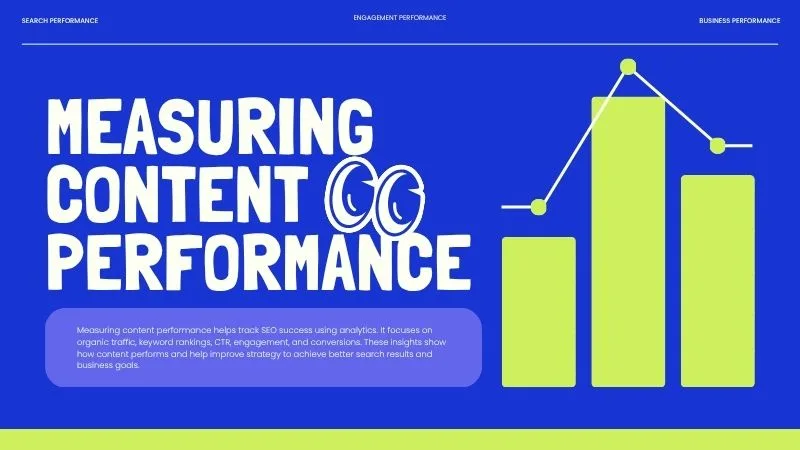
Measuring the performance of your content marketing strategy is the only way to prove its value and refine your future efforts. Data-driven insights transform your website from a simple collection of blog posts into a high-performance engine that consistently hits your business goals.
Tracking the Right Metrics
To understand if your content is truly effective, you must look beyond “vanity metrics” like total hits. Instead, focus on how users interact with your site and whether they are following the path you designed for them.
- Behavioral Data: Look at “Average Session Duration” and “Bounce Rate.” If users spend five minutes on a technical guide but only ten seconds on a tool, you know which format is providing more value.
- Conversion Tracking: Every piece of content should lead to an action – whether it’s a newsletter sign-up, a tool download, or a click on an affiliate link.
Key Performance Indicators (KPIs)
A mature content strategy tracks performance across three main layers:
1. Search Performance
- Organic Traffic: The total number of visitors coming from search engines.
- Keyword Rankings: Tracking your “Top 3” and “Top 10” positions for core topics.
- Click-Through Rate (CTR): Measuring how many people click your link in search results versus just seeing it.
2. Engagement Performance
- Pages per Session: Are users exploring your “Topic Clusters,” or leaving after one page?
- Scroll Depth: How far down the page are readers going? This tells you if your introduction is working or if the middle of the post is too dense.
3. Business Performance
- Lead Generation: How many potential customers are entering your sales funnel through your content?
- ROI (Return on Investment): Comparing the cost of content creation (writer fees, developer time) against the revenue generated by that specific traffic.
The Analytics Workflow
To keep your content marketing strategy agile, you should perform regular performance reviews:
- Monthly Audits: Check which blog posts are gaining momentum and which are losing organic traffic.
- Heatmap Analysis: Use tools to see where users click on your custom HTML blocks. If they ignore a button, move it, or change the color.
- A/B Testing: Try different headlines or Call-to-Action (CTA) placements to see what drives better results for your business goals.
Turning Data into Action
Data is useless if it doesn’t lead to change. If the analytics show that your “How-to” guides get high organic traffic but low engagement, your strategy might need to pivot toward adding more interactive elements, like calculators or videos, to keep users interested.
In Short
Measuring performance is the final step in the loop of a successful content marketing strategy. By constantly monitoring how your content aligns with your business goals, you ensure that every hour spent on content creation contributes to your long-term growth and authority.
Common Mistakes to Avoid
Even the most well-intentioned content creation can fail if it falls into common traps that alienate readers and trigger red flags for search engines. Avoiding these beginner mistakes is just as important as following a solid strategy.
1. Focusing on Search Engines Over Humans
One of the biggest mistakes content creators make is writing exclusively for algorithms. While you want to rank, your primary goal is to provide value to your target audience.
- The Mistake: Writing dry, robotic text that repeats a phrase 20 times.
- The Fix: Write for the human first, then optimize the structure (headers, metadata) for the machine.
2. Destructive Keyword Stuffing
In the early days of the web, repeating a word over and over helped you rank. In 2026, keyword stuffing is a fast track to a manual penalty or a shadow-ban from search results.
- The Mistake: “If you need a UPI QR code generator, our UPI QR code generator is the best UPI QR code generator for your UPI QR code generator needs.”
- The Fix: Use latent semantic indexing (LSI) and natural variations. Talk about “digital payments,” “scan-to-pay features,” and “transaction security” instead of repeating the same phrase.
3. Ignoring User Intent
If your target audience is looking for a quick tool and you give them a 3,000-word history of mathematics, they will leave immediately.
- The Mistake: Misaligning the content format with what the user actually wants.
- The Fix: Look at the top results on search engines for your topic. If they are all “Top 10” lists, don’t try to rank with a single product review.
4. Neglecting Technical Performance
You can create content that is Pulitzer-prize worthy, but if the page takes 10 seconds to load, no one will ever read it.
- The Mistake: Using massive, unoptimized images or heavy, bloated WordPress themes.
- The Fix: Use WebP images, minify your CSS/JS, and ensure your custom HTML blocks are lightweight and mobile-responsive.
Also, check: High-Converting WordPress Themes (100% Free)
5. Lack of Consistency and “Content Rot”
Publishing ten blog posts in one week and then disappearing for three months signals to search engines that your site is unreliable.
- The Mistake: Starting strong but failing to maintain an editorial calendar or update old facts.
- The Fix: Set a realistic schedule (e.g., one high-quality post per week) and stick to it.
In Short
Successful content creation is about balance. Avoid the temptation of keyword stuffing and technical shortcuts. By keeping your target audience at the center of your efforts and respecting the quality guidelines of modern search engines, you build a brand that lasts.
Content Strategy Framework
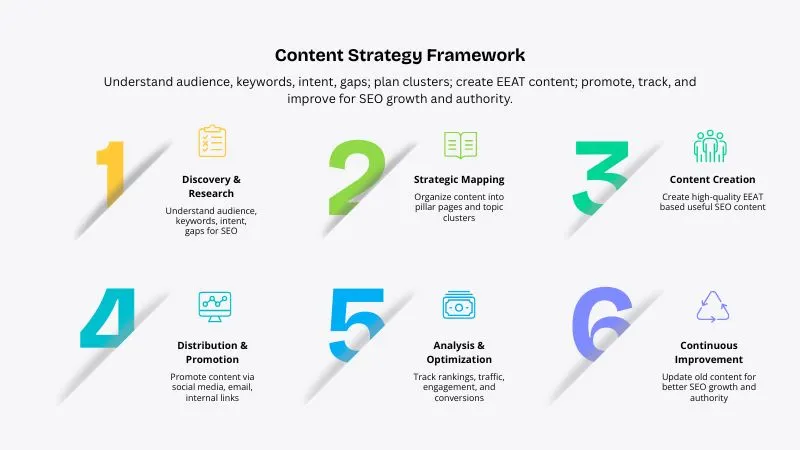
To build a high-authority digital presence in 2026, you need a repeatable content strategy that bridges the gap between technical optimization and human value. This framework acts as your master blueprint, ensuring every content marketing strategy you deploy is aligned with your core business goals.
The 5-Pillar Content Framework
Pillar 1: Discovery & Research
Before you create content, you must understand the landscape. This stage involves deep-diving into your target audience and identifying the “Information Gain” you can provide.
- Action: Conduct keyword research, analyze competitor gaps, and define your unique selling proposition (USP).
- Goal: Finding the “sweet spot” where user problems meet your expertise.
Pillar 2: Strategic Mapping
This is where the content strategy takes shape. You organize your ideas into a “Hub and Spoke” model (Topic Clusters).
- Action: Create a “Pillar Page” (the Hub) and link it to several supporting blog posts (the Spokes).
- Goal: Signalling deep topical authority to both users and engines.
Pillar 3: The Creation Engine
With the map ready, the process of content creation begins. This is the tactical phase where quality meets technical standards.
- Action: Writing high-EEAT articles, coding custom HTML utility tools, and optimizing for AEO (Direct Answers).
- Goal: Producing a piece of content that is faster, more accurate, and more helpful than anything else on page one.
Pillar 4: Distribution & Amplification
Content doesn’t work if it isn’t seen. You must push your assets through multiple channels to kickstart organic traffic.
- Action: Share on social media, send to your email list, and build internal links from high-authority pages.
- Goal: Maximizing the reach of your content marketing effort.
Pillar 5: Analysis & Optimization
The framework is a loop, not a straight line. You must measure how well you are hitting your business goals.
- Action: Check rankings, analyze user dwell time, and update existing content that is starting to decay.
- Goal: Continuous improvement and long-term sustainability.
Framework Implementation Checklist
| Phase | Key Question | Success Metric |
| Research | Who is our target audience? | Search Volume / Intent Match |
| Planning | How does this fit the content strategy? | Editorial Calendar Clarity |
| Execution | Is this the best content creation possible? | Readability / Page Speed |
| Promotion | Where will users find this? | Social Engagement / Backlinks |
| Measurement | Did we meet our business goals? | Conversion Rate / Organic Growth |
In Short
A solid content strategy framework takes the guesswork out of digital growth. By moving systematically from research to measurement, you ensure that every piece of content you produce serves as a building block for your site’s authority and revenue.
Conclusion
Successfully navigating the digital landscape in 2026 requires more than just high-volume production; it requires a sophisticated content strategy that treats every word and every line of code as a business asset. By balancing technical precision with human-centric value, you move beyond being just another search result and become a trusted authority in your niche.
Final Summary
The journey from a blank page to a high-ranking asset is a continuous cycle of planning, execution, and refinement. When you align your content strategy with clear business goals, you stop chasing vanity metrics and start building a sustainable platform that works for you 24/7.
- Strategy provides the “why” and “how,” ensuring your efforts are targeted and efficient.
- Creation provides the “what,” delivering the high-quality value that keeps users on your page.
- Optimization ensures that search engines and AI engines can find, understand, and recommend your work.
The Path to Growth
Whether your objective is to increase brand awareness among a new audience or to maximize organic traffic for a specific tool, the framework remains the same:
- Understand your audience’s intent deeply.
- Produce content that is faster, cleaner, and more helpful than the competition.
- Distribute your work across multiple channels to build a resilient ecosystem.
- Measure your results and update your assets to stay ahead of “content decay.”
Final Checklist for Success
- [ ] Is your content strategy data-driven?
- [ ] Does your content provide a direct answer for AEO?
- [ ] Is your site technically optimized for AIO and speed?
- [ ] Does every piece of content move you closer to your business goals?
By maintaining this discipline, you transform your website into a powerful engine of growth that survives algorithm shifts and AI disruptions alike. The future belongs to those who provide the most value in the most efficient way possible.
Ready to transform your digital presence from a hobby into a high-growth asset? The difference between a site that struggles and one that dominates is a professional content strategy that works for you 24/7.
Take Your Next Step
Don’t leave your growth to chance. Whether you are just starting to create content or looking to fix a declining content marketing strategy, now is the time to act.
- Audit Your Site: Check if your top 5 pages still align with your 2026 goals.
- Build Your Calendar: Map out your next four weeks of topics today.
- Optimize for AI: Ensure your most important answers are clear and direct.
Start Building Your Authority Today
A successful content strategy is a marathon, not a sprint. The sooner you align your technical execution with user intent, the faster you will see your rankings and revenue climb.
What is the first “Topic Cluster” you plan to build this month?
FAQ
1. What is content strategy?
The disciplined practice of planning, creating, and managing content to solve business problems and serve audience needs.
2. How is it different from content marketing?
Content strategy is the blueprint; content marketing is the execution. Strategy defines the goal – marketing drives the results.
3. Where do I start?
Audit what you already have. Then define one clear goal – more traffic, better leads, stronger brand trust.
4. What are the key elements?
Audience insight, brand voice, format mix, distribution plan, and governance (who does what and when).
5. How do I define my audience?
Build 2–3 buyer personas. Include goals, frustrations, and where they consume content.
6. Which content formats work best?
The formats your audience actually uses. Blogs for SEO, video for engagement, case studies for trust, newsletters for loyalty.
7. How often should I publish?
Consistency beats volume. Pick a rhythm you can sustain – weekly or bi-weekly often works best.
8. How do I measure success?
Track metrics tied directly to your goal. Common ones: organic traffic, time on page, conversion rate, or share of voice.
9. What is a content calendar?
A single source of truth that maps topics, formats, channels, and publish dates – keeps your team aligned.
10. Do I need a content team?
Start lean. A strategist + one creator can go far. Build the team as your ROI proves itself.