Key Takeaways
- Ubersuggest wins on price and simplicity. Plans run $29 to $99 a month, and the dashboard is built for people who don’t want to spend a week learning the interface.
- Ahrefs wins on depth, especially backlinks. Its index updates constantly, and Site Explorer remains one of the most trusted competitor research tools in SEO.
- The pricing gap is bigger than most people realize. Ahrefs starts at $129/month for its first “real” plan (Lite), while Ubersuggest’s top tier costs less than Ahrefs’ cheapest one.
- Both tools cover the same core ground: keyword research, competitor analysis, content ideas, site audits, and backlink tracking. The difference is depth, not category.
- Ubersuggest fits freelancers, solo bloggers, and small local businesses. Ahrefs fits agencies, in-house SEO teams, and anyone running client work at scale.
- Test before you commit. Ahrefs doesn’t offer a real free trial anymore, so use Ahrefs Free or Ubersuggest’s trial to see which interface you actually enjoy using.
If you’ve been Googling “Ubersuggest vs Ahrefs,” you’ve probably noticed something. Almost every comparison post reads the same. Same bullet points, same vague conclusion, same “it depends on your needs” cop-out.
Here’s a version that actually tells you something.
I pulled live pricing from both companies, dug through every core feature, and compared this against how these tools get used in the real world, not just on a features page. By the end, you’ll know exactly which tool fits your budget and your skill level, with zero guessing.
Ubersuggest vs Ahrefs: Quick Comparison Table
| Feature | Ubersuggest | Ahrefs |
|---|---|---|
| Starting Price | $29/month | $29/month (Starter, limited) or $129/month (Lite, first full plan) |
| Top Price | $99/month | $449/month (Advanced) or $1,499/month (Enterprise) |
| Free Plan | Yes, limited daily searches | Yes, Ahrefs Free, limited to verified sites |
| Free Trial | Yes, 7-day trial | No traditional full-platform trial |
| Ease of Use | Beginner-friendly, clean UI | More powerful, steeper learning curve |
| Keyword Research | Strong, AI-powered suggestions | Excellent, Traffic Potential metric |
| Backlink Analysis | Solid, good for most small sites | Industry-leading, updates constantly |
| Site Audit | Simple, easy to act on | Deep, with health scores and severity tiers |
| AI Search Visibility | Built in across all plans | Available via Brand Radar add-on |
| Best For | Freelancers, bloggers, small business owners | Agencies, in-house teams, enterprise sites |
What Is Ubersuggest?
Ubersuggest is Neil Patel’s SEO tool, built around one core idea: make SEO data understandable for people who aren’t full-time SEO specialists.
It handles keyword research, competitor analysis, content ideas, site audits, and backlink tracking, all from a dashboard that doesn’t require a manual to figure out.
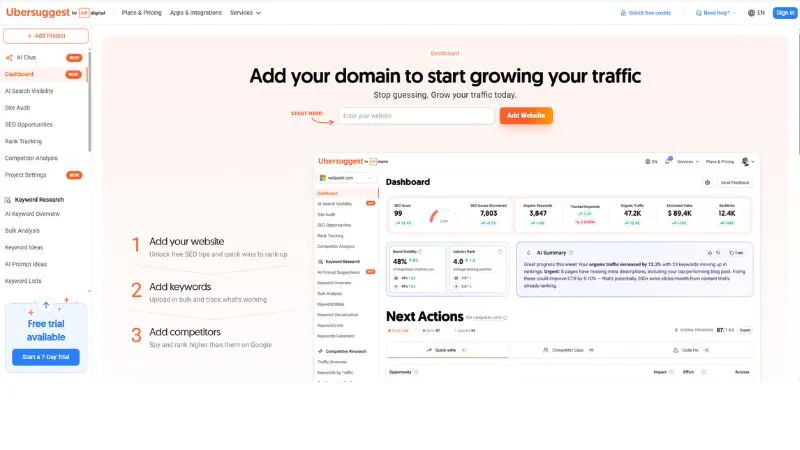
The 2026 version has leaned hard into AI. You’ll now find AI Search Visibility tracking (how often your brand shows up in ChatGPT and Gemini responses), AI Prompt research, and an AI Chat feature baked right into the sidebar. This isn’t a bolt-on either. It sits front and center in the navigation, alongside the Dashboard and Site Audit tools.
If you’ve used Ubersuggest before and haven’t logged in for a while, the interface will feel different. It’s shifted from a pure keyword tool into something closer to a full AI-and-search visibility platform.
What Is Ahrefs?
Ahrefs built its reputation on one thing: backlinks. For years, it was simply the backlink tool serious SEOs used to find link opportunities and reverse-engineer competitor strategies.
That reputation still holds. But Ahrefs has grown well past backlinks. Today, it includes Site Explorer, Keywords Explorer, Site Audit, Rank Tracker, Content Explorer, and newer additions like Brand Radar for AI search visibility and a built-in Web Analytics tool.
If you want the full breakdown of every Ahrefs feature, pricing tier, and use case, check out our complete Ahrefs review. For this comparison, we’re keeping the focus tight on how it stacks up against Ubersuggest specifically.
The short version: Ahrefs gives you more data, more filters, and more depth in nearly every category. The tradeoff is cost and a steeper learning curve.
Ubersuggest vs Ahrefs: Keyword Research
This is where most people start, so let’s start here, too.
Ubersuggest’s keyword research is built to get you from “I have no idea what to write about” to “here’s my next 20 articles” fast. Type in a keyword or a competitor’s domain, and you’ll see search volume, keyword difficulty, cost per click, and a search volume trend chart.
The newer Labs feature adds a keyword generator that analyzes both your site and your competitors’ sites to suggest keywords worth targeting. It’s a smart addition because it removes the guesswork of picking seed keywords manually.
Ahrefs’ Keywords Explorer does all of this too, but with more horsepower behind it. The standout metric here is Traffic Potential, which estimates total traffic for a topic rather than just one keyword’s search volume. That matters because a single page rarely ranks for just one phrase. If you’re targeting “best protein powder for women,” that page will likely also pull traffic from a dozen related searches. Traffic Potential tries to capture that whole picture instead of one narrow number.
Ahrefs also breaks Keyword Difficulty down using the actual backlink profiles of ranking pages, which tends to be more reliable than difficulty scores based on looser signals.
The real difference? Ubersuggest gets you usable keyword ideas fast with a minimal learning curve. Ahrefs gets you deeper insight if you’re willing to spend time understanding metrics like Traffic Potential and how to use them strategically.
For someone publishing one or two posts a week on a personal blog, Ubersuggest is plenty. For an agency running keyword strategy across a dozen client sites, Ahrefs’ depth starts paying for itself.
Ubersuggest vs Ahrefs: Competitive Analysis
Want to know what your competitors are doing right? Both tools can show you, just at different resolutions.
Ubersuggest lets you plug in a competitor’s website and instantly surfaces other competing sites along with the keywords they rank for. Click into any competitor, and you’ll see shared keywords, estimated traffic, and gaps where you’re missing out. It’s straightforward, and for most small business owners, it’s enough to spot two or three quick-win opportunities.
Ahrefs’ Site Explorer goes further. It separates organic and paid traffic, lets you filter for easy-to-rank keywords, and shows you a competitor’s top-performing pages along with the estimated value of those pages. You can even compare a competitor’s site at two different points in time, which is genuinely useful for understanding their growth pattern, not just their current snapshot.
One Ahrefs feature worth calling out: the site structure report. It lets you reverse-engineer how a competitor has organized their content, which can reveal content silo strategies you’d never spot just by browsing their blog manually.
If you’re a freelancer doing a quick competitor check before a client pitch, Ubersuggest covers it. If you’re building a full competitive content strategy for a six-figure SEO campaign, Ahrefs’ depth justifies the extra cost.
Ubersuggest vs Ahrefs: Content Ideas
Good content starts with knowing what’s already working. Both tools approach this from slightly different angles.
Ubersuggest’s Content Ideas tool shows top-performing content for any keyword, including estimated visits, backlinks, and social shares across Facebook, Reddit, and Pinterest. That social data is a nice touch. It tells you not just what ranks, but what people actually share.
Ahrefs’ Content Explorer pulls similar data (traffic, social shares, domain ratings) but adds filters to find topics generating the most backlinks and to monitor how often competitors are publishing. That publishing frequency filter is genuinely useful if you’re trying to figure out whether a competitor is actively investing in content or coasting on old posts.
Neither tool replaces actual editorial judgment. Both are research aids, not content strategists. But if you need volume and filtering depth, Ahrefs edges ahead. If you need something fast and easy to interpret, Ubersuggest does the job without overwhelming you.
Ubersuggest vs Ahrefs: Site Audits
Technical SEO problems are sneaky. Visitors don’t notice them. Google does.
Ubersuggest’s Site Audit flags page-level issues: missing metadata, low word counts, and missing H1 tags. It also checks load time and response speed, both tied to Core Web Vitals. Everything is presented clearly enough that you can fix issues without needing a developer to translate the report for you.
Ahrefs’ Site Audit digs deeper. It calculates an overall health score based on the percentage of error-free URLs, then splits issues into three severity tiers: Error, Warning, and Notice. That tiering matters because it tells you what to fix first instead of leaving you with a wall of 200 flagged issues and no sense of priority.
Ahrefs also checks for security gaps like missing HTTPS and flags architecture problems, such as weak internal linking. Its Page Explorer tool lets you go further still, comparing source code across crawls over time, which is overkill for a small site but genuinely valuable for a large one with frequent changes.
Bottom line: Ubersuggest’s audit tells you what’s broken. Ahrefs’ audit tells you what’s broken, how severe it is, and how your whole site’s health compares over time.
Ubersuggest vs Ahrefs: Backlink Analysis
This is Ahrefs’ home turf, and it shows.
Ubersuggest’s backlink tool gives you a solid overview: domain authority, referring domains, total backlinks, and backlink growth over time. You can filter by referring domain type, dig into new and lost links, and export data if you want to analyze it elsewhere. For most small sites, this covers what you need to know.
Ahrefs is widely considered the strongest backlink tool on the market, and a big reason why is its update frequency. The index refreshes every 15 minutes. That’s not a typo. While Ubersuggest and most competitors update on a daily or weekly cycle, Ahrefs is catching new and lost links in near real time.
Beyond raw speed, Ahrefs offers features Ubersuggest doesn’t match: a “404 not found” filter for broken link-building campaigns, and spam link detection to flag unnatural links pointing at your site before they become a problem.
If backlinks are central to your SEO strategy (and for competitive niches, they usually are), this is the category where Ahrefs’ higher price tag is easiest to justify.
Here’s our full breakdown of the best backlink checker tools if you want to compare more than just Ubersuggest and Ahrefs.
Ubersuggest vs Ahrefs: AI Search Visibility
This is the newest battleground, and both tools have entered it differently.
Ubersuggest has built AI Search Visibility directly into every plan. You get AI Model Insights covering ChatGPT and Gemini, with update cycles ranging from monthly on the entry plan to weekly on the top tier. It also tracks AI prompts per project, so you can see what people are actually asking AI assistants in your niche, and whether your brand shows up in the answers.
Ahrefs approaches this through Brand Radar, which researches brand visibility across 271 million-plus organic prompts and lets you track custom prompts. It’s powerful, but it’s priced as an add-on starting around $199/month, separate from the core plans, with additional custom prompt packages running $50 to $250/month depending on volume.
If AI search visibility matters to your strategy right now (and it increasingly does, given how many people are skipping Google entirely for ChatGPT), Ubersuggest includes this without an extra line item. Ahrefs’ version is arguably more powerful given its prompt database size, but you’re paying separately for it.
Ubersuggest Pricing in 2026
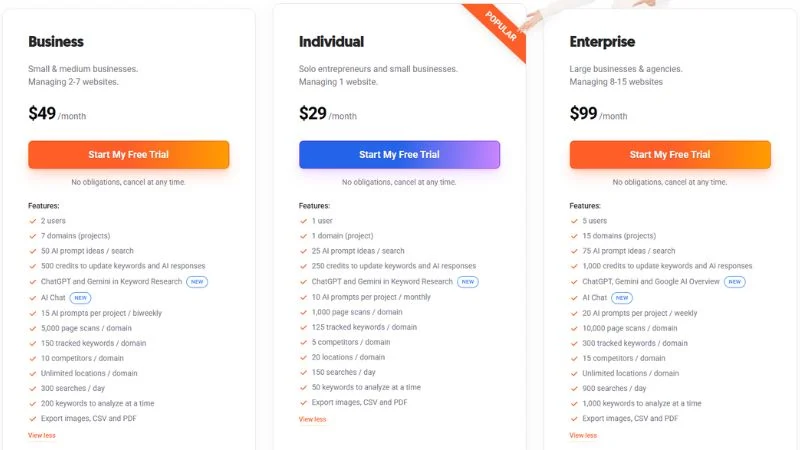
Ubersuggest pricing has shifted to a cleaner three-tier structure:
| Plan | Price | Domains | Tracked Keywords | Site Audit Pages |
|---|---|---|---|---|
| Individual | $29/month | 1 | 125/week | 1,000/week |
| Business | $49/month | 7 | 150/week | 5,000/week |
| Enterprise/SEO Agency | $99/month | 15 | 300/week | 10,000/week |
Every plan includes AI Search Visibility, keyword research with AI model insights, competitive analysis, backlink tracking, and rank tracking. Add-ons like extra tracked keywords, more domains, or additional AI prompts run $5/month each, so you can scale a single plan up without jumping to the next tier.
Ubersuggest also runs lifetime-access promotions periodically, something Ahrefs doesn’t offer at all.
Ahrefs Pricing in 2026
Ahrefs pricing looks deceptively simple until you read the fine print.
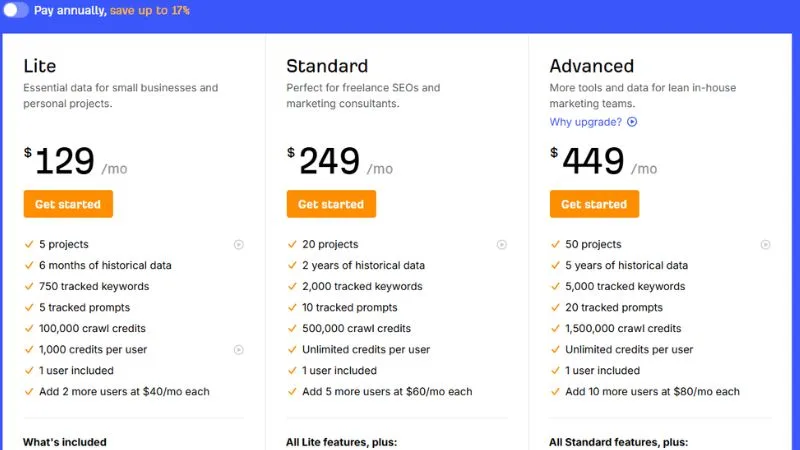
| Plan | Price | Projects | Tracked Keywords | Crawl Credits |
|---|---|---|---|---|
| Starter | $29/month | Limited | Limited | Limited |
| Lite | $129/month | 5 | 750 | 100,000 |
| Standard | $249/month | 20 | 2,000 | 500,000 |
| Advanced | $449/month | 50 | 5,000 | 1,500,000 |
| Enterprise | $1,499/month | 100+ | From 10,000 | From 5,000,000 |
Notice that the Starter plan is at $29/month. On paper, it matches UberSuggest’s entry price exactly. In practice, it’s heavily restricted, more of a “try before you upgrade” tier than a tool you’d run a real SEO strategy on. Most people serious about Ahrefs end up on Lite at minimum, and many outgrow that within a few months and move to Standard.
Annual billing knocks up to 17% off, and additional users cost $40 to $100/month per seat, depending on your tier. Ahrefs doesn’t offer discounts otherwise, and there’s no full-platform free trial. Your only way to test it without paying is Ahrefs Free, which gives limited access to Site Explorer and Site Audit for verified websites only.
Ubersuggest vs Ahrefs: Pricing Reality Check
Here’s the comparison that actually matters once you strip away the marketing pages.
Ubersuggest’s most expensive plan ($99/month) costs less than Ahrefs’ cheapest functional plan ($129/month for Lite). If budget is your main constraint, this single fact probably answers your question before you read another word of this article.
But price alone doesn’t tell the whole story. Ahrefs’ Lite plan, despite costing more than Ubersuggest’s top tier, gives you fewer tracked keywords (750 vs. Ubersuggest’s 300 on its top plan) but far more crawl credits and a stronger backlink index. You’re not paying more for more of the same thing. You’re paying more for deeper data in specific categories, mainly backlinks and historical tracking.
If you’re a freelancer billing one or two clients, that depth might not be worth the jump. If you’re running SEO for a competitive ecommerce site or managing multiple client accounts, it often is.
Which One Is Easier to Use?
Ubersuggest wins this category without much argument.
The dashboard groups everything logically: AI Chat and Dashboard up top, then Site Audit, SEO Opportunities, Rank Tracking, the full Keyword Research suite, and Link Building tools below. Nothing requires a tutorial to find. If you’ve used basically any modern SaaS dashboard, Ubersuggest will feel familiar within minutes.
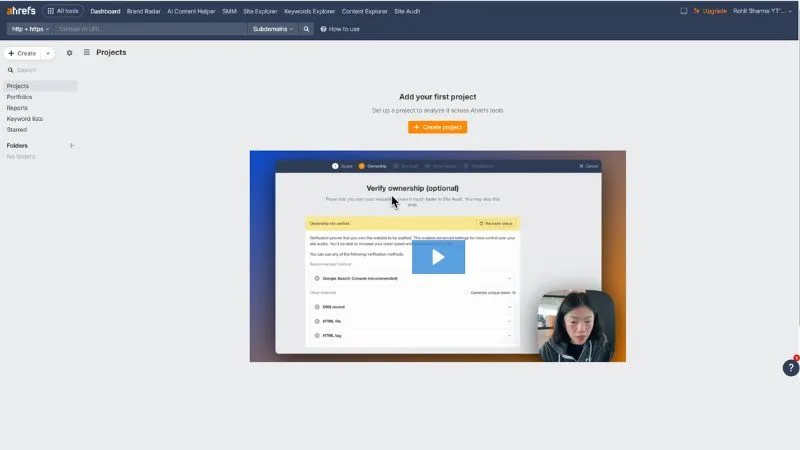
Ahrefs isn’t unusable by any means. Its interface has actually gotten cleaner over the years. But the sheer volume of features, filters, and metrics means there’s a real learning curve. You’ll want to spend time in Ahrefs Academy or watch a few tutorials before you use Site Explorer and Keywords Explorer to their full potential.
If you’ve never used an SEO tool before, Ubersuggest is the gentler on-ramp. If you’ve used Semrush or another full-featured platform before, Ahrefs’ learning curve will feel much shorter.
Who Should Use Ubersuggest?
Ubersuggest makes the most sense if you fit one of these profiles:
- Solo bloggers and content creators who need keyword ideas and basic competitor insight without a steep learning curve
- Freelance marketers and small agencies managing a handful of client sites on a tight software budget
- Local businesses that need straightforward SEO guidance without enterprise-level data
- SEO beginners who want to learn the fundamentals without getting lost in advanced filters and metrics
If your monthly SEO software budget tops out around $50 to $100, Ubersuggest gives you nearly everything you need in one place.
Who Should Use Ahrefs?
Ahrefs makes more sense once your SEO operation gets more serious:
- Agencies managing multiple client accounts that need deep competitor and backlink data to justify retainers
- In-house SEO teams at companies where organic traffic is a primary revenue channel
- Competitive niches where backlink quality and quantity genuinely move the needle
- Anyone doing serious technical SEO audits across large or complex websites
If you’ve outgrown Ubersuggest, or you’re managing SEO where the cost of a missed opportunity is higher than $129/month, Ahrefs starts paying for itself.
Frequently Asked Questions
Is Ubersuggest as good as Ahrefs?
They’re good at different things. Ubersuggest is easier to use and strong for keyword research on a budget. Ahrefs goes deeper on backlinks, technical audits, and competitor research, but costs significantly more and takes longer to learn.
Is Ubersuggest free to use?
Ubersuggest offers limited free access with a capped number of daily searches. For full functionality, paid plans start at $29/month, and there’s a 7-day free trial available.
Does Ahrefs have a free trial?
No. Ahrefs doesn’t offer a traditional free trial for its full platform. You can use Ahrefs Free, which gives limited access to Site Explorer and Site Audit for websites you own and verify, or start with the $29/month Starter plan to test core features.
Which is cheaper, Ubersuggest or Ahrefs?
Ubersuggest is cheaper overall. Its top plan costs $99/month, which is still less than Ahrefs’ entry-level Lite plan at $129/month. Ahrefs’ Starter plan matches Ubersuggest’s $29/month entry price, but it’s heavily limited compared to Ubersuggest’s equivalent tier.
Which tool is better for backlink research?
Ahrefs. Its index updates every 15 minutes, compared to Ubersuggest’s slower refresh cycle, and it includes advanced features like broken link-building filters and spam link detection that Ubersuggest doesn’t match.
Can I use both Ubersuggest and Ahrefs together?
Yes, and some agencies do exactly that. Use Ubersuggest for quick keyword research and content ideas, then bring in Ahrefs for deep backlink analysis or competitive audits on high-priority projects. It’s not necessary for most small sites, but it’s a valid strategy if budget allows.
Is Ahrefs worth it for a small blog?
Usually not right away. If you’re just starting out and publishing your first batch of articles, Ubersuggest or even free tools like Google Search Console will cover your needs. Ahrefs becomes worth the investment once your blog has enough content and competition to justify deeper data.
Final Verdict
Both tools cover the same core ground: keyword research, competitor analysis, content ideas, site audits, and backlinks. The real difference comes down to depth versus accessibility.
Ubersuggest is the better starting point for most solo creators, freelancers, and small businesses. It’s affordable, the dashboard doesn’t require a learning curve, and the AI Search Visibility features are now built into every plan instead of sold as an add-on.
Ahrefs is the better choice once your SEO needs outgrow the basics. The backlink data alone justifies the price for competitive niches, and the technical audit depth is hard to match anywhere else.
My honest advice: if you’re not sure which one fits, start with Ubersuggest’s free trial. It costs you nothing but a week, and you’ll know quickly whether you need more firepower than it offers. If you hit its limits within a month, that’s your sign to look at Ahrefs Lite.