Love him or question his methods, one truth remains undeniable in 2026. Neil Patel dominates search engine results like few others online. His websites attract millions of monthly visitors. His tools generate thousands of leads daily. His name appears everywhere marketers gather.
Most people assume his success comes from aggressive backlinking or sheer publishing volume. The data tells a different story.
After analyzing seventy-five of his actual pages using an SEO tool, a clear pattern emerged. Neil Patel SEO strategy is not random. It is not lucky. It is a masterfully engineered content funnel that educates readers, hooks them with free tools, and converts them through Ubersuggest.
This article dissects Neil Patel SEO strategy piece by piece, revealing exactly how his content empire operates in 2026.
What You Will Discover in This Analysis
- How his educational pillars attract millions of beginners searching for fundamentals
- Why his niche blog posts on platforms like Pinterest, GA4, and Quora capture targeted traffic that competitors ignore
- The technical SEO foundation he builds with schema markup, site speed optimization, and voice search readiness
- His 2026 AI strategy for dominating ChatGPT, Gemini, and Google’s AI Overviews
- How Ubersuggest functions as the monetization engine behind everything
- Seven actionable lessons you can apply to your own website starting today
No fluff. No theory. Just a data-backed analysis of one of marketing’s most successful content machines using seventy-five real pages as evidence.
What is Neil Patel’s SEO strategy?
Neil Patel’s SEO strategy combines educational pillar content, niche blog posts targeting specific platforms, free tools that capture leads, technical SEO optimization, and a product funnel that drives users toward Ubersuggest. His approach focuses on answering real user questions, building authority through comprehensive coverage, and converting readers through low-friction tool access.
Who Is Neil Patel in 2026?
Neil Patel is not just another marketing blogger. He is the co-founder of NP Digital, a performance marketing agency serving enterprise clients worldwide. He is the creator of Ubersuggest, an all-in-one SEO tool used by over 250,000 marketers. He is a Wall Street Journal bestselling author. And he is arguably the most recognizable face in digital marketing today.
But in 2026, his identity has evolved.
For more marketing insights, you can
visit Neil Patel's websiteand explore his latest guides.
What Defines His 2026 Presence
- Content Creator: His blog publishes weekly deep dives on everything from AI SEO to Pinterest advertising
- Tool Builder: Ubersuggest now includes AI-powered keyword research, site audits, and competitor analysis
- Agency Leader: NP Digital runs campaigns for brands you know
- YouTube Educator: His channel breaks down complex topics into actionable advice
- AI Strategist: He actively teaches how to optimize for ChatGPT, Gemini, and Google’s AI Overviews
His “About” page frames him as someone who started in SEO as a teenager and never stopped learning. His digital marketing services page positions NP Digital as the solution for companies wanting professional execution. His training section offers courses for those who prefer self-guided education.
Why Study Neil Patel in 2026?
Because his methods are transparent. He shows his work. He publishes his wins and his failures. He adapts when Google updates shake the industry.
Neil Patel’s SEO strategy works because it evolves. When AI Overviews launched, he published guides on adapting. When voice search grew, he created voice search SEO content. When platforms like Pinterest and Quora became search engines themselves, he covered them thoroughly.
What makes Neil Patel different from other marketing experts in 2026?
Unlike experts who focus on only one channel, Neil Patel builds integrated systems. He creates educational content that ranks in search, develops free tools that capture leads, runs an agency that serves enterprise clients, and continuously adapts to algorithm changes.
His unique advantage is connecting every piece of his ecosystem back to Ubersuggest, creating a seamless path from reader to user to customer.
How This Connects to His SEO Strategy
Every asset above serves Neil Patel’s SEO strategy in a specific way:
- The blog attracts beginners searching for answers
- The free tools capture leads through low-friction entry points
- The agency serves enterprises willing to pay for execution
- The courses monetize dedicated learners wanting deeper knowledge
- YouTube reaches visual learners who prefer video over text
It is not one thing. It is an ecosystem. And every piece feeds into the next.
What His Online Presence Reveals
| Asset | Purpose | Funnel Stage | Traffic Goal |
|---|---|---|---|
| Educational Blog | Answers beginner questions, builds authority | Top of funnel | Maximum organic reach |
| Niche Blog Posts | Targets specific platforms and tools | Top to middle | Captures engaged readers |
| Free SEO Tools | Provides instant value, captures emails | Middle of funnel | Lead generation |
| Ubersuggest App | All-in-one SEO platform for ongoing use | Middle to bottom | User conversion |
| YouTube Channel | Reaches visual learners, builds brand | Top of funnel | Brand awareness |
| NP Digital Agency | Enterprise services for high-budget clients | Bottom of funnel | Revenue |
| Training Courses | Monetizes dedicated learners | Bottom of funnel | Revenue |
| AI Tools Subdomain | Experiments with cutting-edge SEO | Top to middle | Early adopter capture |
What This Table Reveals
- Every asset serves a specific purpose in the ecosystem
- No single piece works alone – they all connect
- The funnel is seamless – readers become tool users become customers
- Traffic goals vary, but all feed the same machine
The Funnel Top – Educational Content That Captures Beginners
Every successful marketing funnel begins with a wide opening. Neil Patel’s SEO strategy starts exactly there.
His educational content serves as that opening. Pages explaining fundamental concepts attract visitors who are just starting their journey. These readers arrive with questions, not credit cards. They want definitions, explanations, and actionable advice they can implement immediately.
And there are millions of them searching every single day.
Pillar Pages That Dominate Search Results
At the foundation of his content empire are comprehensive pillar pages. These are not shallow blog posts. They are complete guides that cover topics from every angle.
His “What Is SEO” guide exemplifies this approach. It defines search engine optimization, explains ranking factors, breaks down technical audits, and covers everything a beginner needs to know. The page structure uses clear headings, numbered lists, and concise definitions.
Other pillar pages follow the same pattern:
- “What Is Affiliate Marketing” explains commission structures, tracking methods, and promotion strategies
- “What Is Google AdWords” covers paid search fundamentals, bidding strategies, and campaign setup
- “What Is Digital Marketing” provides a broad overview of channels and tactics
Each of these pages targets searchers at the very beginning of their learning journey. And each one ranks prominently because they deliver exactly what those searchers need: complete, trustworthy answers.
Marketing Fundamentals That Never Go Out of Style
Beyond SEO-specific content, his site covers marketing basics that remain relevant year after year. These topics have consistent search volume because new marketers discover them constantly.
Posts about the “4 Ps of Marketing” explain product, price, place, and promotion in ways beginners can understand. Articles on the “Product Life Cycle” walk through introduction, growth, maturity, and decline stages. Guides explaining “How Marketing Funnels Work” break down awareness, consideration, and conversion.
These topics are not flashy. They do not trend on social media. But they attract steady traffic from people building foundational knowledge. And every reader who lands on these pages encounters his name, his tools, and his approach.
Answer Engine Optimization – How He Wins Featured Snippets
Modern search behavior extends beyond traditional Google queries. Voice search continues growing. Featured snippets dominate mobile results. AI overviews now appear above organic listings.
Neil Patel’s SEO strategy adapts to these changes naturally.
His pillar pages use direct answers to common questions. They structure content with bullet points that Google can pull into position zero. They include definitions that voice assistants can read aloud.
Look at his “What Is SEO” page. The opening paragraphs answer the core question immediately. Subsequent sections use H3 headings that mirror actual search queries. This structure signals to search engines that the page contains direct, useful answers.
When someone asks Siri, “What is search engine optimization?” the information likely originates from content structured exactly like this. When ChatGPT explains marketing fundamentals, it synthesizes explanations similar to its guides.
How His Content Wins Featured Snippets
| Technique | Example | Result |
|---|---|---|
| Direct answers first | “SEO stands for search engine optimization” | Immediate value |
| Question-based H3s | “Why Is SEO Important?” | Matches voice search |
| Bulleted lists | Key takeaways at top | Snippet-friendly |
| Concise definitions | 1-2 sentences per term | Easy to pull |
Beginner-Friendly Tone That Welcomes Everyone
Perhaps the most overlooked aspect of his content is the tone. He writes for people who do not yet know the jargon. He explains terms before using them. He assumes curiosity, not expertise.
This matters enormously for Neil Patel’s SEO strategy because beginners search differently from experts. They use natural language. They ask basic questions. They click on content that feels accessible.
His pages avoid intimidating readers with complexity. They use short sentences. They include examples. They break concepts into small, digestible pieces.
A beginner landing on his site does not feel stupid. They feel guided. And that feeling keeps them reading, clicking, and eventually trying his tools.
Data That Proves This Works
The numbers speak for themselves. His “What Is SEO” guide ranks on Google’s first page for its target keyword. It attracts thousands of monthly visitors. It generates backlinks from other sites referencing its explanations.
His marketing fundamentals posts maintain steady traffic year after year. They do not spike and fade. They compound, building authority over time.
According to industry data, search accounts for over forty percent of traffic to typical websites. Educational content drives the largest share of that traffic because informational searches represent billions of daily queries.
By capturing beginners at the very top of the funnel, Neil Patel’s SEO strategy ensures a constant flow of new visitors into his ecosystem. Some will leave and never return. Others will click a tool link, try a free feature, and begin their journey toward becoming users.
How does Neil Patel attract millions of visitors to his site?
Neil Patel attracts millions through comprehensive educational content targeting beginners. His pillar pages on topics like “What Is SEO” and marketing fundamentals answer basic questions clearly. He structures content for featured snippets, uses beginner-friendly language, and covers timeless topics that generate consistent search traffic year after year.
Specialized Guides That Leave No Topic Behind

Pillar pages capture beginners searching for fundamentals. But Neil Patel’s SEO strategy does not stop there.
His blog dives deep into specific platforms, tools, and tactics that attract readers with more focused interests. These visitors already know basic concepts. They want advanced strategies, platform-specific guidance, and actionable tactics they can apply immediately.
And he delivers exactly that.
Platform-Specific Deep Dives
Social platforms have become search engines themselves. Instagram processes billions of searches daily. TikTok’s discovery algorithm shapes trends. Pinterest users actively research products. YouTube is the second-largest search engine in the world.
His content covers each platform thoroughly.
The Pinterest advertising guide walks through ten specific strategies. It explains promoted pins, video pins, and one-tap pins. It covers audience targeting, bid strategies, and visual best practices. Anyone searching for Pinterest ad advice finds a complete resource.
The Google Analytics 4 guide addresses the platform transition that confused countless marketers. It explains what GA4 is, how it differs from Universal Analytics, and exactly how to set it up. For marketers struggling with the change, this post provides clarity.
The Meta Business Suite tutorial covers managing Facebook and Instagram from one dashboard. It explains unified inbox, content calendar, insights, and ad creation. Business owners juggling multiple accounts find practical help.
Other platform-specific posts tackle Quora marketing, Amazon Vendor Central, and YouTube video ideas. Each one targets a specific audience with specific needs.
Timely vs. Evergreen – Balancing Both
Notice something important about his content mix. Some posts target evergreen topics that will always get searched. Others chase timely trends and platform updates.
This balance serves Neil Patel’s SEO strategy in two ways:
| Content Type | Purpose | Examples |
|---|---|---|
| Evergreen | Consistent traffic, compounding authority | Marketing fundamentals, SEO basics |
| Timely | Capture trends, show relevance | GA4 migration, AI updates |
| Platform-specific | Target engaged niche audiences | Pinterest ads, Meta Business Suite |
Evergreen posts build the foundation. Timely posts capture surges in search interest. Platform-specific posts attract readers already further along in their journey.
The Internal Linking Web
Read any of his blog posts, and you will notice something consistent. They link to each other constantly.
A post about Pinterest advertising links to keyword research guides. A GA4 tutorial links to site audit tools. A Quora marketing guide links to content distribution strategies.
This internal linking structure serves multiple purposes:
- Readers discover related content and stay on the site longer
- Link authority flows between related pages
- Search engines understand topic relationships
- The funnel guides readers from general to specific
No post exists in isolation. Every piece connects to others, creating a web that keeps readers moving through the ecosystem.
Content Silos That Build Authority
Group his posts by topic, and patterns emerge. He builds content silos around specific themes.
All social media marketing posts connect to each other. All SEO technical guides form another cluster. All tool-related content points toward Ubersuggest.
These silos signal expertise to search engines. When Google sees multiple authoritative pages covering related topics, it recognizes the site as a trusted resource for that subject area.
Neil Patel’s SEO strategy leverages this fully. His site does not rank for one or two keywords. It ranks for thousands because Google trusts its comprehensive coverage of marketing topics.
The “Ubersuggest” Connection
Here is where the strategy gets really smart.
Every niche blog post promotes Ubersuggest naturally. Not with aggressive sales pitches. With contextual relevance.
The Pinterest advertising guide mentions keyword research and suggests using Ubersuggest to find Pinterest keywords. The GA4 tutorial references site audit features available in the tool. The Meta Business Suite post connects to competitor analysis capabilities.
By the time readers finish these posts, they have encountered Ubersuggest multiple times. They have seen it mentioned in contexts that make sense. They have developed curiosity about what the tool can do for their specific situation.
How Blog Posts Feed the Tool Funnel
| Post Topic | Tool Feature Mentioned | Reader Action |
|---|---|---|
| Pinterest ads | Keyword research | Try Ubersuggest for Pinterest keywords |
| GA4 setup | Site audit | Check their own site health |
| Meta Business Suite | Competitor analysis | See what competitors are doing |
| Quora marketing | Content ideas | Find questions to answer |
| YouTube video ideas | Keyword volume | Validate video topics |
Free Tools as Lead Magnets
Beyond blog content, standalone tool pages serve as powerful entry points.
The website traffic checker lets anyone estimate traffic for any domain. Enter a URL, get instant data. No signup required at first use.
The backlink checker reveals who links to any site. See competitor backlinks, find new opportunities, and export data.
The site audit tool scans websites for technical issues. Identify problems that hurt rankings.
These tools provide immediate value with zero friction. Users get what they came for. And along the way, they encounter prompts to create accounts for more features.
Calculators and Generators – Low-Friction Entry Points
Even simpler than the tools are his calculators and generators.
The A/B testing calculator helps marketers estimate test duration and significance. The Open Graph generator creates social sharing previews.
These micro-tools serve a specific purpose. They attract users with a specific, immediate need. They solve that need instantly. And they introduce those users to the broader Ubersuggest ecosystem.
What types of content does Neil Patel publish on his blog?
Neil Patel publishes platform-specific deep dives on Pinterest, Google Analytics 4, Meta Business Suite, Quora, and Amazon. He balances evergreen topics with timely updates. Every post connects to others through internal linking and promotes Ubersuggest naturally. Free tools and calculators provide low-friction entry points that capture leads.
Technical SEO – What You Don’t See but Google Loves
Content attracts visitors. Technical SEO ensures they can find it. Neil Patel’s SEO strategy invests heavily in the behind-the-scenes foundation that makes everything else work.
Schema Markup Strategy
His site uses structured data extensively. The FAQ schema makes its Q&A sections eligible for rich results. Article schema helps Google understand the content type. HowTo schema guides step-by-step tutorials.
This markup tells search engines exactly what his content means, not just what it says.
Site Speed Optimization
Slow sites lose visitors. His loading time guides emphasize this repeatedly. Pages load quickly because images compress properly, code minifies efficiently, and server response times stay low.
Every second of delay reduces conversions. His technical foundation respects this reality.
Site Architecture and Internal Linking
Remember those internal links from Section 4? They do more than keep readers clicking. They pass authority throughout the site.
Key pages receive more internal links. Authority flows to new content. Search engines crawl deeper because the architecture guides them.
Mobile-First Indexing Readiness
Google indexes mobile versions first. His site passes this test easily. Short paragraphs, readable fonts, and touch-friendly buttons make the mobile experience seamless.
Voice Search Optimization
Voice searches use natural language. His content matches this with conversational phrasing, direct answers, and question-based headings.
When someone asks, “How fast should my site load?” his content has the answer ready.
E-commerce SEO Guidance
For sites selling products, his e-commerce SEO guides cover product pages, category structure, and review markup. The principles apply whether you run a store or a content site.
Off-Page SEO Philosophy
Links matter. His off-page SEO content teaches earning links through quality, not building them through schemes. Digital PR, guest contributions, and valuable content attract natural backlinks.
Technical SEO Checklist from His Content
| Element | What He Teaches |
|---|---|
| Schema Markup | FAQ, article, HowTo types |
| Site Speed | Compress, minify, optimize |
| Internal Links | Connect related content |
| Mobile Readiness | Short paragraphs, touch-friendly |
| Voice Search | Conversational answers |
| Ecommerce Structure | Product pages, reviews |
| Link Building | Quality over quantity |
What technical SEO factors does Neil Patel emphasize?
Neil Patel emphasizes schema markup for rich results, site speed optimization, internal linking architecture, mobile-first design, voice search readiness, and ethical link building. His technical foundation ensures search engines can crawl, understand, and rank his content effectively.
How Neil Patel Is Winning the AI SEO Game
AI changed everything. Search results now include AI Overviews. ChatGPT answers questions directly. Gemini pulls from web content. Neil Patel’s SEO strategy evolved right along with it.
What Is His Approach to AI Content Creation?
He does not hide from AI. He uses it strategically. His blog covers AI content generation extensively, teaching when to use AI and when human input remains essential.
The key takeaway? AI assists. It does not replace. Want to see the data behind his strategy? Check our Neil Patel Organic Keywords for the US guide.
How Does AI Keyword Research Work in Ubersuggest?
Ubersuggest now includes AI-powered keyword features. The tool identifies brands mentioned by AI models. It generates keyword ideas based on search intent. It predicts which terms will drive traffic before competitors notice them.
This gives users a significant advantage in the AI search landscape.
What Is Generative Engine Optimization?
GEO means optimizing for AI platforms like ChatGPT and Gemini. His content achieves this through clarity, structure, and authority.
Clear definitions help AI understand topics. Structured content with headings helps AI pull relevant sections. Authoritative information makes AI trust and cite the source.
How Does He Optimize for Google AI Overviews?
His “What Is SEO” page explicitly mentions AI overviews as position zero. But more importantly, the content structure itself aligns with what AI Overviews look for:
- Direct answers first
- Bulleted lists for quick scanning
- Comprehensive coverage of subtopics
- Clear heading hierarchy
What AI Tools Does He Offer?
The dedicated AI tools subdomain experiments with cutting-edge applications. These micro-tools attract early adopters and position him at the forefront of AI marketing.
AI SEO Checklist from His Content
| AI Element | What He Teaches |
|---|---|
| AI Content | Use AI for drafts, humans for final polish |
| AI Keywords | Target terms AI models mention |
| GEO | Structure content for ChatGPT and Gemini |
| AI Overviews | Direct answers, bullet points, comprehensive coverage |
| AI Tools | Experiment with dedicated AI applications |
What This Means for Your Strategy
- Structure content clearly – AI needs to parse what you write
- Answer questions directly – No burying the lead
- Build authority consistently – AI trusts sites others trust
- Experiment with AI tools – Early adopters win
Ubersuggest – The Engine That Monetizes It All
Every piece of content eventually points here. Ubersuggest is not just another SEO tool. It is the destination where Neil Patel’s SEO strategy converts readers into users and users into customers.
What Free Tools Hook Users First?
The entry points are simple and friction-free:
- Website traffic checker – Estimate any domain’s traffic instantly
- Backlink checker – See who links to competitors
- Site audit tool – Identify technical issues hurting rankings
No credit card required. No lengthy signup. Just immediate value.
From here, you can
try Ubersuggest for free to analyze your SEOand find keywords your competitors rank for.
What Does the App Ecosystem Include?
Once users enter, the full platform unfolds:
| Feature | What It Does |
|---|---|
| Dashboard | Central hub for all SEO data |
| Keyword Ideas | AI-powered keyword suggestions |
| Competitor Analysis | See what rivals rank for |
| Traffic Analyzer | Estimate any site’s organic traffic |
| Site Audit | Crawl and fix technical issues |
| Backlink Data | Track link profile over time |
How Does His Pricing Strategy Convert?
The lifetime deal stands out. Pay once, access forever. This removes monthly subscription friction and makes the decision easy.
Compared to competitors charging hundreds monthly, Ubersuggest pricing feels accessible. Free tier users see enough value to upgrade. Upgraded users stay because the tool delivers.
What Features Make Ubersuggest Stand Out?
- AI keyword research – Finds terms others miss
- Content ideas – Based on what’s already ranking
- Rank tracking – Monitor positions daily
- Site audits – Fix what’s broken
How Does the Login Wall Capture Emails?
Try any advanced feature, and you will encounter a login prompt. This simple gate captures emails while still providing enough free value to keep users engaged.
Every email becomes a lead. Every lead receives nurturing. Every nurtured user may eventually convert.
What Is the Content-to-Product Pipeline?
Blog post teaches → Mentions relevant tool feature → Reader tries free version → Prompt to create account → Email capture → Nurturing → Upgrade
This pipeline repeats across hundreds of blog posts, driving thousands of users into the ecosystem daily.
Ubersuggest Fast Facts
| Metric | Number |
|---|---|
| Users | 250,000+ |
| Pricing | Lifetime option available |
| Key Features | AI keywords, site audit, competitor analysis |
| Entry Points | Free tools + blog content |
What is Ubersuggest, and how does it fit into Neil Patel’s strategy?
Ubersuggest is Neil Patel’s all-in-one SEO tool that serves as the monetization engine for his content empire. Free tools like traffic checker and backlink analyzer hook users. The full platform offers AI keyword research, site audits, and competitor analysis. His content funnel guides readers from blog posts to tool usage to paid conversion.
NP Digital – The Agency Behind the Brand
Some readers want to learn. Some want tools. And some want experts to just do it for them. Neil Patel’s SEO strategy captures all three.
How Does He Capture Enterprise Clients?
NP Digital handles what businesses cannot or will not do themselves. The agency runs SEO campaigns, content marketing, and paid media for companies ready to scale.
His digital marketing services page speaks directly to this audience. No tutorials. No DIY advice. Just professional execution.
What Training and Education Does He Offer?
For those between DIY and full agency, training courses provide structured learning. Deep dives into specific topics let enthusiasts level up without hiring help.
Where Do You See the Full-Service Option?
Look closely at his blog posts. Many include a callout: “If you want my team to just do your marketing for you, click here.”
This single line captures readers who read, nod, and thought “I need this done, not just explained.”
The Complete Funnel
| Layer | Audience | Solution |
|---|---|---|
| Top | Beginners learning | Free blog content |
| Middle | Active practitioners | Ubersuggest tools |
| Upper Middle | Dedicated learners | Training courses |
| Bottom | Businesses ready to scale | NP Digital agency |
Does Neil Patel offer services beyond Ubersuggest?
Yes. NP Digital is his full-service agency handling SEO, content marketing, and paid media for enterprise clients. He also offers training courses for those wanting structured education. Blog callouts invite readers to hire his team for execution.
If DIY isn’t your style,
visit NP Digitallet the experts handle your campaigns.
7 Lessons You Can Apply Today
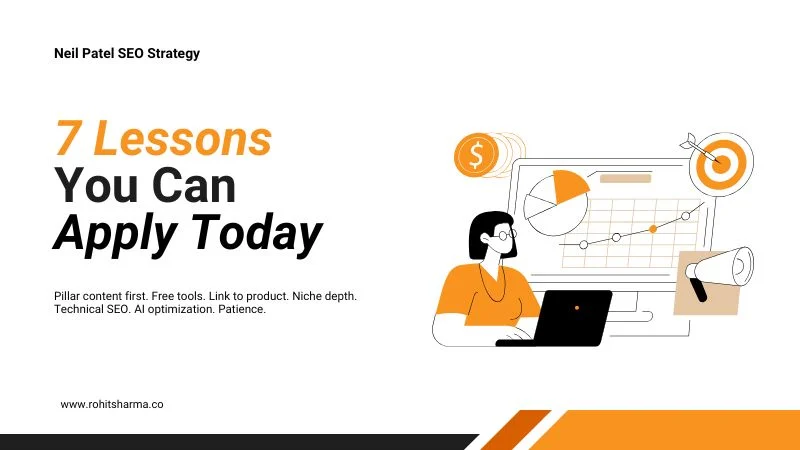
You have seen how Neil Patel’s SEO strategy works. Now here is how to make it yours.
Lesson 1 – Build Pillars Before Posts
Start with comprehensive guides on fundamental topics. Answer the questions beginners ask. Establish authority before chasing niche topics.
Action: Write one 3,000-word pillar page before ten 500-word posts.
Lesson 2 – Create Free Tools
Tools capture leads while you sleep. They do not need to be complex. Start with calculators, checkers, or generators that solve one specific problem.
Action: Build one simple tool that delivers immediate value.
Lesson 3 – Link Everything to Your Product
Every piece of content should eventually point toward what you sell. Not aggressively. Naturally. Use contextual relevance, not sales pitches.
Action: Audit your last ten posts. How many mention your product naturally?
Lesson 4 – Go Deep on Niche Topics
Cover specific platforms, tools, and tactics thoroughly. Become the authority for that specific angle. Niche depth beats shallow breadth.
Action: Pick one platform your audience uses. Write the definitive guide.
Lesson 5 – Master Technical SEO
Content gets people to your site. Technical SEO keeps them there and helps Google find you. Schema, speed, and structure matter.
Action: Run a site audit today. Fix what is broken.
Lesson 6 – Optimize for AI
Structure content for ChatGPT, Gemini, and AI Overviews. Use direct answers, clear headings, and bullet points. Make it easy for AI to summarize you.
Action: Add one question-based H3 with a direct answer to your next post.
Lesson 7 – Be Patient
His empire took years to build. You will too. Consistency compounds. Keep publishing, keep improving, keep serving.
Action: Commit to one post per week for six months. No excuses.
Lessons at a Glance
| Lesson | One-Sentence Summary |
|---|---|
| 1 | Pillars first, posts second |
| 2 | Build simple free tools |
| 3 | Link everything to your product |
| 4 | Go deep on niche topics |
| 5 | Master technical fundamentals |
| 6 | Structure content for AI |
| 7 | Be patient and consistent |
What are the key lessons from Neil Patel’s SEO strategy?
The seven key lessons are: build pillar content first, create free tools, link everything to your product, go deep on niche topics, master technical SEO, optimize for AI platforms, and remain patient. Consistency and serving user needs matter more than quick wins.
Frequently Asked Questions About Neil Patel’s SEO Strategy
What is Neil Patel’s SEO strategy?
Neil Patel’s SEO strategy combines educational pillar content, niche blog posts targeting specific platforms, free tools that capture leads, technical SEO optimization, and a product funnel that drives users toward Ubersuggest. His approach focuses on answering real user questions, building authority through comprehensive coverage, and converting readers through low-friction tool access.
Does Neil Patel use Ubersuggest for his own SEO?
Yes. Ubersuggest powers much of his keyword research, competitor analysis, and site auditing. The tool reflects what he actually uses, making it practical rather than theoretical.
How does Neil Patel rank #1 for so many keywords?
He ranks through comprehensive content, strategic internal linking, technical SEO foundation, and consistent publishing. His site covers topics completely, signals expertise through depth, and earns backlinks naturally because others reference his guides.
Is Neil Patel’s SEO advice still relevant in 2026?
Absolutely. His content continuously updates to reflect algorithm changes, AI search evolution, and platform shifts. His January 2026 digital marketing roundup and AI SEO guides prove he stays current.
What tools does Neil Patel use besides Ubersuggest?
His stack includes Ahrefs and SEMrush for competitive data, Google Analytics 4 for traffic analysis, Google Search Console for indexing insights, and various social media management tools. But Ubersuggest remains his core SEO platform.
How can I replicate Neil Patel’s success?
Start with one pillar page on a fundamental topic. Add free tools that solve specific problems. Link everything back to what you offer. Go deep on niche subjects. Master technical basics. Structure for AI. And stay consistent for years.
FAQ NP Digital
| Question | Answer Summary |
|---|---|
| What is his strategy? | Pillars + niche posts + tools + technical + funnel |
| Does he use Ubersuggest? | Yes, for keyword research and site audits |
| How does he rank #1? | Comprehensive content + internal links + technical foundation |
| Is his advice still relevant? | Yes, continuously updated for 2026 |
| What tools does he use? | Ubersuggest, Semrush, GA4, Search Console |
| How to replicate? | Pillars, tools, links, depth, technical, AI, patience |
Final Thoughts – What You Can Build Today
Neil Patel’s SEO strategy is not magic. It is not luck. It is an engineered system where every piece serves a purpose.
The Funnel Recap
- Educational pillars attract beginners searching for answers
- Niche blog posts capture engaged readers seeking specific guidance
- Free tools provide immediate value and capture leads
- Ubersuggest converts users through genuine utility
- NP Digital serves those ready to scale
- Technical foundation makes everything discoverable
- AI optimization ensures relevance in 2026 and beyond
What Makes This Analysis Different
You just read insights drawn from seventy-five actual pages. Not guesses. Not theory. Real content, real patterns, real strategy.
This is what winning looks like when you look under the hood.
What is the main takeaway from Neil Patel’s SEO strategy?
The main takeaway is that his success comes from an integrated ecosystem, not any single tactic. Educational content, free tools, technical SEO, AI optimization, and a clear product funnel work together. Readers can apply this by building pillar content first, creating simple tools, and consistently linking everything back to what they offer.
Your Next Steps
Start today. Not tomorrow. Not next month.
- Write one pillar page answering your audience’s biggest question
- Build one free tool that solves a specific problem
- Audit your technical SEO and fix what is broken
- Structure your next post for AI and voice search
- Link everything back to what you offer
Which lesson will you implement first?
Pick one. Start this week. Come back and tell us how it went in the comments.
The blueprint is yours now. Go build something great.
If you found this breakdown helpful, share it with a friend who needs to level up their SEO game. They’ll thank you later.”